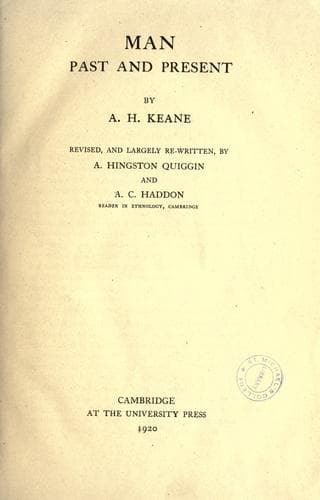
Man, Past and PresentKeane, A. H. (Augustus Henry)
History
Man, Past and Present
Keane, A. H. (Augustus Henry)
Anthropology; Ethnology
The ethnological parting-line between the Malayan and Papuasian races,
as first laid down by Wallace, nearly coincides with his division
between the Indo-Malayan and Austro-Malayan floras and faunas, the chief
differences being the positions of Sumbawa and Celebes. Both of these
islands are excluded from the Papuasian realm, but included in the
Austro-Malayan zoological and botanical regions.
THE OCEANIC NEGRITOES.
Recent discoveries and investigations of the pygmy populations on the
eastern border of the Indian Ocean tend to show that the problem is by
no means simple. Already two main stocks are recognised, differentiated
by wavy and curly hair and dolichocephaly in the Sakai, and so-called
woolly hair in the Andamanese Islanders, Semang (Malay Peninsula) and
Aeta (Philippines), combined with mesaticephaly or low brachycephaly. In
East Sumatra and Celebes a short, curly-haired dark-skinned people
occur, racially akin to the Sakai, and Moszkowski suggests that the same
element occupied Geelvink Bay (Netherlands New Guinea). These with the
Vedda of Ceylon, and some jungle tribes of the Deccan, represent
remnants of a once widely distributed pre-Dravidian race, which is also
supposed to form the chief element in the Australians[341].
The "Mincopies," as the Andamanese used to be called, nobody seems to
know why, were visited in 1893 by Louis Lapicque, who examined a large
kitchen-midden near Port Blair, but some distance from the present
coast, hence of great age[342]. Nevertheless he failed to find any
worked stone implements, although flint occurs in the island. Indeed,
chipped or flaked flints, now replaced by broken glass, were formerly
used for shaving and scarification. But, as the present natives use only
fishbones, shells, and wood, Lapicque somewhat hastily concluded that
these islanders, like some other primitive groups, have never passed
through a Stone Age at all. The shell-mounds have certainly yielded an
arrow-head and polished adze "indistinguishable from any of the European
or Indian celts of the so-called Neolithic period[343]." But there is no
reason to think that the archipelago was ever occupied by a people
different from its present inhabitants. Hence we may suppose that their
ancestors arrived in their Stone Age, but afterwards ceased to make
stone implements, as less handy for their purposes and more difficult to
make than the shell or bone-tipped weapons and the nets with which they
capture game and fish more readily "than the most skilful fisherman with
hook and line[344]." Similarly they would seem to have long lost the art
of making fire, having once obtained it from a still active volcano in
the neighbouring Barren Island[345].
Public-domain text, read in full here on John Shaqi.
Reviews
Reviews
No reviews yet
Be the first to share your thoughts on this work.
Elsewhere in the archive
Join the Discussion
Join the discussion
Sign in to leave a comment or review.
Sign InorCreate an account