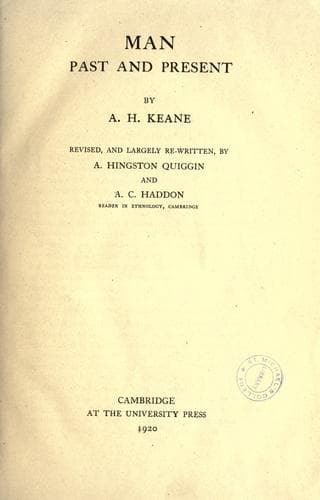
Man, Past and PresentKeane, A. H. (Augustus Henry)
History
Man, Past and Present
Keane, A. H. (Augustus Henry)
Anthropology; Ethnology
The inhabitants of the Andaman Islands range in colour from bronze to
sooty black. Their hair is extremely frizzly, seeming to grow in spiral
tufts and is seldom more than 5 inches long when untwisted. The women
usually shave their heads. Their height is about 1.48 m. (4 ft. 10-1/2
in.), with well-proportioned body and small hands. The cephalic index
averages 82. The face is broad at the cheek-bones, the eyes are
prominent, the nose is much sunken at the root but straight and small;
the lips are full but not thick, the chin is small but not retreating,
nor do the jaws project. The natives are characterised by honesty,
frankness, politeness, modesty, conjugal fidelity, respect for elders
and real affection between relatives and friends. The women are on an
equal footing with the men and do their full share of work. The food is
mainly fish (obtained by netting, spearing or shooting with bow and
arrow), wild yams, turtle, pig and honey. They do not till the soil or
keep domestic animals. Instead of clothing both sexes wear belts,
necklaces, leg-bands, arm-bands etc. made of bones, wood and shell, the
women wearing in addition a rudimentary leaf apron. When fully dressed
the men wear bunches of shredded Pandanus leaf at wrists and knees, and
a circlet of the same leaf folded on the head. They make canoes, some of
which have an outrigger, but never venture far from the shore. They
usually live in small encampments round an oval dancing ground, their
simple huts are open in front and at the sides, or in a large communal
hut in which each family has its own particular space, the bachelors and
spinsters having theirs. A family consists of a man and his wife and
such of their children, own and adopted, as have not passed the period
of the ceremonies of adolescence. Between that period and marriage the
boys and girls reside in the bachelors' and spinsters' quarters
respectively. A man is not regarded as an independent member of the
community till he is married and has a child. There is no organised
polity. Generally one man excels the rest in hunting, warfare, wisdom
and kindliness, and he is deferred to, and becomes, in a sense, chief. A
regular feature of Andamanese social life is the meeting at intervals
between two or more communities. A visit of a few days is paid and
presents are exchanged between hosts and guests, the time being spent in
hunting, feasting and dancing.
Public-domain text, read in full here on John Shaqi.
Reviews
Reviews
No reviews yet
Be the first to share your thoughts on this work.
Elsewhere in the archive
Join the Discussion
Join the discussion
Sign in to leave a comment or review.
Sign InorCreate an account