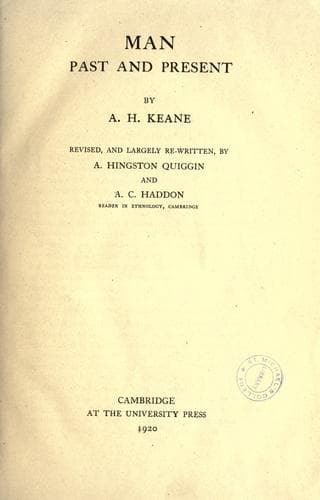
Man, Past and PresentKeane, A. H. (Augustus Henry)
History
Man, Past and Present
Keane, A. H. (Augustus Henry)
Anthropology; Ethnology
No forms of worship have been noticed, but there is a belief in various
kinds of spirits, the most important of whom is Biliku, usually regarded
as female, who is identified with the north-east monsoon and is paired
with Tarai the south-west monsoon. Biliku and Tarai are the producers of
rain, storms, thunder and lightning. Fire was stolen from Biliku. There
is always great fluidity in native beliefs, so some tribes regard Puluga
(Biliku) as a male. Three things make Biliku angry and cause her to send
storms; melting or burning of bees-wax, interfering in any way with a
certain number of plants, and killing a cicada or making a noise during
the time the cicadae are singing. A. R. Brown[346] gives an interesting
explanation of this curious belief. Biliku is supposed to have a human
form but nobody ever sees her. Her origin is unknown. The idea of her
being a creator is local and is probably secondary, she does not concern
herself with human actions other than those noted above.
E. H. Man has carefully studied and reduced to writing the Andamanese
language, of which there are at least nine distinct varieties,
corresponding to as many tribal groups. It has no clear affinities to
any other tongue[347], the supposed resemblances to Dravidian and
Australian being extremely slight, if not visionary. Its phonetic system
is astonishingly rich (no less than 24 vowels and 17 consonants, but no
sibilants), while the arithmetic stops at _two_. Nobody ever attempts to
count in any way beyond _ten_, which is reached by a singular process.
First the nose is tapped with the finger-tips of either hand, beginning
with the little finger, and saying _ubatul_ (one), then _ikpor_ (two)
with the next, after which each successive tap makes _anka_, "and this."
When the thumb of the second hand is reached, making _ten_, both hands
are brought together to indicate 5 + 5, and the sum is clenched with the
word _arduru_ = "all." But this feat is exceptional, and usually after
_two_ you get only words answering to several, many, numerous,
countless, which flight of imagination is reached at about 6 or 7.
Public-domain text, read in full here on John Shaqi.
Reviews
Reviews
No reviews yet
Be the first to share your thoughts on this work.
Elsewhere in the archive
Join the Discussion
Join the discussion
Sign in to leave a comment or review.
Sign InorCreate an account