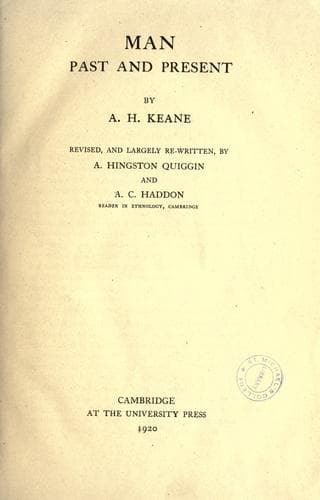
Man, Past and PresentKeane, A. H. (Augustus Henry)
History
Man, Past and Present
Keane, A. H. (Augustus Henry)
Anthropology; Ethnology
But when all the changes in climate are taken into consideration, the
periods of elevation and depression of the land, the transformations of
the animals, the evolution of man, the gradual stages of advance in
human culture, the development of the races of mankind, and their
distribution over the surface of the globe, this estimate is regarded by
many as insufficient. Allen Sturge claims "scores of thousands of years"
for the neolithic period alone[57], and Sir W. Turner points out the
very remote times to which the appearance of neolithic man must be
assigned in Scotland. After showing that there is undoubted evidence of
the presence of man in North Britain during the formation of the Carse
clays, this careful observer explains that the Carse cliffs, now in
places 45 to 50 feet above the present sea-level, formed the bed of an
estuary or arm of the sea, which in post-glacial times extended almost,
if not quite across the land from east to west, thus separating the
region south of the Forth from North Britain. He even suggests, after
the separation of Britain from the Continent in earlier times, another
land connection, a "Neolithic land-bridge" by which the men of the New
Stone Age may have reached Scotland when the upheaved 100-foot terrace
was still clothed with the great forest growths that have since
disappeared[58].
One begins to ask, Are even 100,000 years sufficient for such
oscillations of the surface, upheaval of marine beds, appearance of
great estuaries, renewed connection of Britain with the Continent by a
"Neolithic land-bridge"? In the Falkirk district neolithic
kitchen-middens occur on, or at the base of, the bluffs which overlook
the Carse lands, that is, the old sea-coast. In the Carse of Gowrie also
a dug-out canoe was found at the very base of the deposits, and
immediately above the buried forest-bed of the Tay Valley[59].
That the neolithic period was also of long duration even in Scandinavia
has been made evident by Carl Wibling, who calculates that the
geological changes on the south-east coast of Sweden (Province of
Bleking), since its first occupation by the men of the New Stone Age,
must have required a period of "at least 10,000 years[60]."
Still more startling are the results of the protracted researches
carried on by J. Nueesch at the now famous station of Schweizersbild,
near Schaffhausen in Switzerland[61]. This station was apparently in the
continuous occupation of man during both Stone Ages, and here have been
collected as many as 14,000 objects belonging to the first, and over
6000 referred to the second period. Although the early settlement was
only post-glacial, a point about which there is no room for doubt, L.
Laloy[62] has estimated "the absolute duration of both epochs together
at from 24,000 to 29,000 years." We may, therefore, ask, If a
comparatively recent post-glacial station in Switzerland is about 29,000
years old, how old may a pre- or inter-glacial station be in Gaul or
Britain?
Public-domain text, read in full here on John Shaqi.
Reviews
Reviews
No reviews yet
Be the first to share your thoughts on this work.
Join the Discussion
Join the discussion
Sign in to leave a comment or review.
Sign InorCreate an account