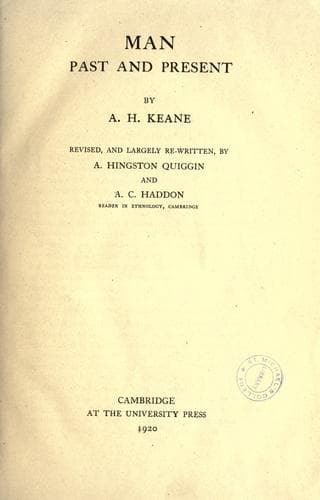
Man, Past and PresentKeane, A. H. (Augustus Henry)
History
Man, Past and Present
Keane, A. H. (Augustus Henry)
Anthropology; Ethnology
Being merely hunters and collectors, with the arrival of English
colonists their doom was sealed. "Only in rare instances can a race of
hunters contrive to co-exist with an agricultural people. When the
hunting ground of a tribe is restricted owing to its partial occupation
by the new arrivals, the tribe affected is compelled to infringe on the
boundaries of its neighbours: this is to break the most sacred 'law of
the Jungle,' and inevitably leads to war: the pressure on one boundary
is propagated to the next, the ancient state of equilibrium is
profoundly disturbed, and inter-tribal feuds become increasingly
frequent. A bitter feeling is naturally aroused against the original
offenders, the alien colonists; misunderstandings of all kinds
inevitably arise, leading too often to bloodshed, and ending in a
general conflict between natives and colonists, in which the former,
already weakened by disagreements among themselves, must soon succumb.
So it was in Tasmania." After the war of 1825 to 1831 the few wretched
survivors, numbering about 200, were gathered together into a
settlement, and from 1834 onwards every effort was made for their
welfare, "but 'the white man's civilisation proved scarcely less fatal
than the white man's bullet,' and in 1877, with the death of Truganini,
the last survivor, the race became extinct[374]."
FOOTNOTES:
[319] Cf. S. H. Ray, _Reports Camb. Anthrop. Exp. Torres Sts._ Vol. III.
1907, pp. 287, 528. For Melanesian linguistic affinities see also W.
Schmidt, _Die Mon-Khmer Voelker_, 1906.
[320] C. G. Seligman limits the use of the term _Papuasian_ to the
inhabitants of New Guinea and its islands, and following a suggestion of
A. C. Haddon's (_Geograph. Journ._ XVI. 1900, pp. 265, 414), recognises
therein three great divisions, the _Papuans_, the _Western
Papuo-Melanesians_, and the _Eastern Papuo-Melanesians_, or _Massim_.
Cf. C. G. Seligman, "A Classification of the Natives of British New
Guinea," _Journ. Roy. Anthr. Inst._ Vol. XXXIX. 1902, and _The
Melanesians of British New Guinea_, 1910.
[321] That is, the indigenous Papuans, who appear to form the great bulk
of the New Guinea populations, in contradistinction to the immigrant
Melanesians (Motu and others), who are numerous especially along the
south-east coast of the mainland and in the neighbouring Louisiade and
D'Entrecasteaux Archipelagoes (_Eth._ Ch. XI.).
[322] _The Melanesians of British New Guinea_, 1910, pp. 2, 27.
[323] The curly or wavy hair appears more commonly among women than
among men.
[324] _Kanaka_ is a Polynesian word meaning "man," and should therefore
be restricted to the brown Indonesian group, but it is indiscriminately
applied by French writers to all South Sea Islanders, whether black or
brown. This misuse of the term has found its way into some English books
of travel even in the corrupt French form "canaque."
[325] _L'Archipel de la Nouvelle Caledonie_, Paris, 1895.
Public-domain text, read in full here on John Shaqi.
Reviews
Reviews
No reviews yet
Be the first to share your thoughts on this work.
Elsewhere in the archive
Join the Discussion
Join the discussion
Sign in to leave a comment or review.
Sign InorCreate an account