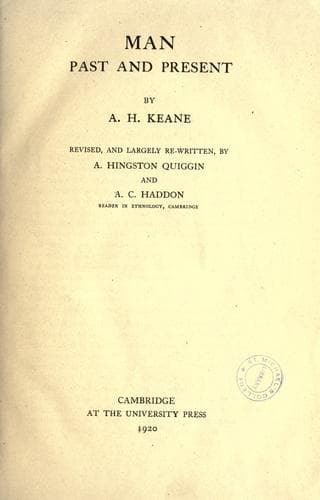
Man, Past and PresentKeane, A. H. (Augustus Henry)
History
Man, Past and Present
Keane, A. H. (Augustus Henry)
Anthropology; Ethnology
These remarks apply more particularly to the settled southern
communities living in districts where a little agriculture is possible.
Elsewhere the religious cloak is worn very loosely, and the nomad
_Horsoks_ of the northern steppes, although all nominal Buddhists, pay
but scant respect to the decrees supposed to emanate from the Dalai Lama
enshrined in Lhasa. Horsok is an almost unique ethnical term[395], being
a curious compound of the two names applied by the Tibetans to the
_Hor-pa_ and the _Sok-pa_ who divide the steppe between them. The
Hor-pa, who occupy the western parts, are of Turki stock, and are the
only group of that race known to me who profess Buddhism[396], all the
rest being Muhammadans with some Shamanists (Yakuts) in the Lena basin.
The Sok-pa, who roam the eastern plains and valleys, although commonly
called Mongols, are true Tibetans or more strictly speaking Tanguts, of
whom there are here two branches, the _Goliki_ and the _Yegrai_, all,
like the Hor-pa, of Tibetan speech. The Yegrai, as described by
Prjevalsky, closely resemble the other North Tibetan tribes, with their
long, matted locks falling on their shoulders, their scanty whiskers
and beard, angular head, dark complexion and dirty garb[397].
Besides stock-breeding and predatory warfare, all these groups follow
the hunt, armed with darts, bows, and matchlock guns; the musk-deer is
ensnared, and the only animal spared is the stag, "Buddha's horse." The
taste of these rude nomads for liquid blood is insatiable, and the
surveyor, Nain Singh, often saw them fall prone on the ground to lick up
the blood flowing from a wounded beast. As soon as weaned, the very
children and even the horses are fed on a diet of cheese, butter, and
blood, kneaded together in a horrible mess, which is greedily devoured
when the taste is acquired. On the other hand alcoholic drinks are
little consumed, the national beverage being coarse Chinese tea imported
in the form of bricks and prepared with _tsampa_ (barley-meal) and
butter, and thus becoming a food as well as a drink. The lamas have a
monopoly of this tea-trade, which could not stand the competition of the
Indian growers; hence arises the chief objection to removing the
barriers of seclusion.
Public-domain text, read in full here on John Shaqi.
Reviews
Reviews
No reviews yet
Be the first to share your thoughts on this work.
Elsewhere in the archive
Join the Discussion
Join the discussion
Sign in to leave a comment or review.
Sign InorCreate an account