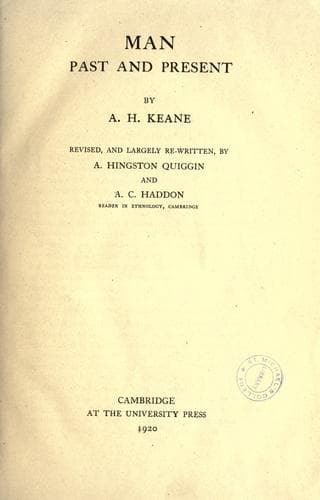
Man, Past and PresentKeane, A. H. (Augustus Henry)
History
Man, Past and Present
Keane, A. H. (Augustus Henry)
Anthropology; Ethnology
Tibet is one of the few regions where polyandrous customs, intimately
associated with the matriarchal state, still persist almost in their
pristine vigour. The husbands are usually but not necessarily all
brothers, and the bride is always obtained by purchase. Unless otherwise
arranged, the oldest husband is the putative "father," all the others
being considered as "uncles." An inevitable result of the institution is
to give woman a dominant position in society; hence the "queens" of
certain tribes, referred to with so much astonishment by the early
Chinese chroniclers. Survivors of this "petticoat government" have been
noticed by travellers amongst the Lolos, Mossos, and other indigenous
communities about the Indo-Chinese frontiers. But it does not follow
that polyandry and a matriarchal state always and necessarily preceded
polygyny and a patriarchal state. On the contrary, it would appear that
polyandry never could have been universal; possibly it arose from
special conditions in particular regions, where the struggle for
existence is severe, and the necessity of imposing limits to the
increase of population more urgent than elsewhere[398]. Hence to me it
seems as great a mistake to assume a matriarchate as it is to assume
promiscuity as the universal antecedent of all later family relations.
In Tibet itself polygyny exists side by side with polyandry amongst the
wealthy classes, while monogamy is the rule amongst the poor pastoral
nomads of the northern steppe.
Great ethnical importance has been attached by some distinguished
anthropologists to the treatment of the dead. But, as in the New Stone
and Metal Ages in Europe cremation and burial were practised side by
side[399], so in Tibet the dead are now simultaneously disposed of in
diverse ways. It is a question not so much of race as of caste or social
classes, or of the lama's pleasure, who, when the head has been shaved
to facilitate the transmigration of the soul, may order the body to be
burnt, buried, cast into the river, or even thrown to carrion birds or
beasts of prey. Strange to say, the last method, carried out with
certain formalities, is one of the most honourable, although the lamas
are generally buried in a seated posture, and high officials burnt, and
(in Ladakh) the ashes, mixed with a little clay, kneaded into much
venerated effigies--doubtless a survival of ancestry worship.
Public-domain text, read in full here on John Shaqi.
Reviews
Reviews
No reviews yet
Be the first to share your thoughts on this work.
Elsewhere in the archive
Join the Discussion
Join the discussion
Sign in to leave a comment or review.
Sign InorCreate an account