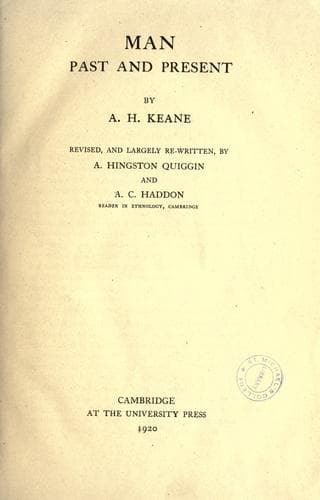
Man, Past and PresentKeane, A. H. (Augustus Henry)
History
Man, Past and Present
Keane, A. H. (Augustus Henry)
Anthropology; Ethnology
A somewhat similar feature is presented by the Angami Naga, the chief
language of the Naga Hills, of which R. B. McCabe writes that it is
"still in a very primitive stage of the agglutinating class," and
"peculiarly rich in intonation," although "for one Naga who clearly
marks these tonal distinctions twenty fail to do so[405]." It follows
that it is mainly spoken without tones, and although said to be
"distinctly monosyllabic" it really abounds in polysyllables, such as
_merenama_, orphan, _kehutsaporimo_, nowhere, _dukriwache_, to kill,
etc. There are also numerous verbal formative elements given by McCabe
himself, so that Angami must clearly be included in the agglutinating
order. To this order also belongs beyond all doubt the _Kuki-Lushai_ of
the neighbouring North Kachar Hills and parts of Nagaland itself, the
common speech in fact of the _Rangkhols_, _Jansens_, _Lushai_, _Roeys_
and other hill peoples, collectively called _Kuki_ by the lowlanders,
and _Dzo_ by themselves[406]. The highly agglutinating character of this
language is evident from the numerous conjugations given by
Soppitt[407], for some of which he has no names, but which may be called
_Acceleratives_, _Retardatives_, _Complementatives_, and so on. Thus
with the root, _ahong_, come, and infix _jam_, slow, is formed the
retardative _nang ahongjamrangmoh_, "will-you-come-slowly?" (_rang_,
future, _moh_, interrogative particle)[408].
The Kuki, the Naga and the Manipuri, none of which claim to be the
original occupants of the country, have a tradition of a common
ancestor, who had three sons who became the progenitors of the tribes.
The Kuki are found almost everywhere throughout Manipur. "We are like
the birds of the air," said a Kuki to T. C. Hodson, "we make our nests
here this year, and who knows where we shall build next year[409]?" The
following description is given of the Naga tribes, _Tangkhuls_, _Mao_
and _Maram Nagas_ (_Angami Nagas_), _Kolya_, or _Mayang Khong_ group,
_Kabuis_, _Quoirengs_, _Chirus_ and _Marrings_. "Differences of stature,
dress, coiffure and weapons make it easy to distinguish between the
members of these tribes. In colour they are all brown with but little
variety, though some of the Tangkhuls who earn their living by salt
making seem to be darker. Among them all, as among the Manipuris, there
are persons who have a tinge of colour in their cheeks when still young.
The nose also varies, for there are cases where it is almost straight,
while in the majority of individuals it is flattened at the nostril.
Here and there one may see noses which in profile are almost Roman. The
eyes are usually brown, though black eyes are sometimes found to occur.
The jaw is generally clean, not heavy, and the hair is of some variety,
as there are many persons whose hair is decidedly curly, and in most
there is a wave. Beards are very uncommon, and hair on the face is very
rare, so much so that the few who possess a moustache are known as
Public-domain text, read in full here on John Shaqi.
Reviews
Reviews
No reviews yet
Be the first to share your thoughts on this work.
Elsewhere in the archive
Join the Discussion
Join the discussion
Sign in to leave a comment or review.
Sign InorCreate an account