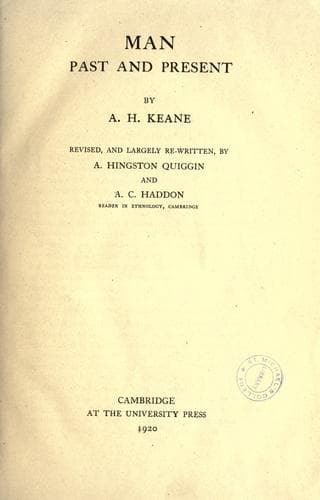
Man, Past and PresentKeane, A. H. (Augustus Henry)
History
Man, Past and Present
Keane, A. H. (Augustus Henry)
Anthropology; Ethnology
That the civilised lowlanders and rude highlanders are generally of the
same aboriginal stocks is well seen in the Manipur district with its
fertile alluvial plains and encircling Naga and Lushai Hills on the
north and south. The Hinduized Manipuri of the plains, that is, the
politically dominant _Meithis_, as they call themselves, are considered
by George Watt to be "a mixed race between the Kukies and the
Nagas[413]." The Meithis are described as possessing in general the
facial characteristics of Mongolian type, but with great diversity of
feature. "It is not uncommon to meet with girls with brownish-black
hair, brown eyes, fair complexions, straight noses and rosy
cheeks[414]." In spite of the veneer of civilisation acquired by the
Meithis, the old order of things has by no means passed away. "The
_maiba_, the doctor and priest of the animistic system, still finds a
livelihood despite the competition on the one hand of the Brahmin, and
on the other of the hospital Assistant. Nevertheless the _maibas_
frequently adapt their methods to the altered circumstances in which
they now find themselves, and realize that the combination of croton oil
and a charm is more efficacious than the charm alone[415]."
"It is possible to discover at least four definite orders of spiritual
beings who have crystallized out from the amorphous mass of animistic
Deities. There are the _Lam Lai_, gods of the country-side who shade off
into Nature Gods controlling the rain, the primal necessity of an
agricultural community; the _Umang Lai_ or Deities of the Forest Jungle;
the _Imung Lai_, the Household Deities, Lords of the lives, the births
and the deaths of individuals, and there are Tribal Ancestors, the
ritual of whose worship is a strange compound of magic and
Nature-worship. Beyond these Divine beings, who possess in some sort a
majesty of orderly decent behaviour, there are spirits of the mountain
passes, spirits of the lakes and rivers, vampires and all the horrid
legion of witchcraft.... It is difficult to estimate the precise effect
of Hinduism on the civilisation of the people, for to the outward
observer they seem to have adopted only the festivals, the outward
ritual, the caste marks and the exclusiveness of Hinduism, while all
unmindful of its spirit and inward essentials. Colonel McCulloch
remarked nearly fifty years ago that 'In fact their observances are only
for appearance sake, not the promptings of the heart[416].'"
Public-domain text, read in full here on John Shaqi.
Reviews
Reviews
No reviews yet
Be the first to share your thoughts on this work.
Elsewhere in the archive
Join the Discussion
Join the discussion
Sign in to leave a comment or review.
Sign InorCreate an account