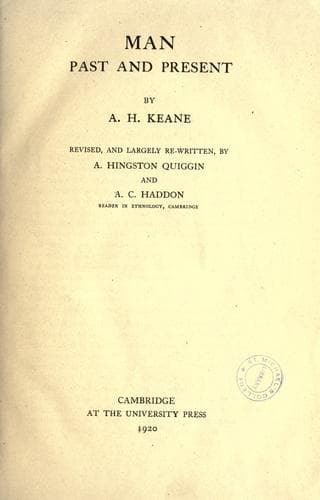
Man, Past and PresentKeane, A. H. (Augustus Henry)
History
Man, Past and Present
Keane, A. H. (Augustus Henry)
Anthropology; Ethnology
It is noteworthy that the Manipuri are also devoted to the game of polo,
which R. C. Temple tells us they play much in the same way as do the
Balti and Ladakhi at the opposite extremity of the Himalayas. Another
remarkable link with the "Far West" is the term _Khel_, which has
travelled all the way from Persia or Parthia through Afghanistan to
Nagaland, where it retains the same meaning of clan or section of a
village, and produces the same disintegrating effects as amongst the
Afghans. In Angamiland each village is split into two or more Khels, and
"it is no unusual state of affairs to find Khel A of one village at war
with Khel B of another, while not at war with Khel B of its own village.
The Khels are often completely separated by great walls, the people on
either side living within a few yards of each other, yet having no
dealings whatever. Each Khel has its own headman, but little respect is
paid to the chief: each Khel maybe described as a small republic[417]."
There appears to be no trace even of a _jirga_, or council of elders, by
which some measure of cohesion is imparted to the Afghan Khel system.
From the Kuki-Nagas the transition is unbroken to the large group of
_Chins_ of the Chindwin valley, named from them, and thence northwards
to the rude _Kakhyens_ (_Kachins_) about the Irawadi headstreams and
southwards to the numerous _Karen_ tribes, who occupy the ethnical
parting-line between Burma and Siam all the way down to Tenasserim.
For the first detailed account of the Chins we are indebted to S. Carey
and H. N. Tuck[418], who accept B. Houghton's theory that these tribes,
as well as the Kuki-Lushai, "originally lived in what we now know as
Tibet, and are of one and the same stock; their form of government,
method of cultivation, manners and customs, beliefs and traditions, all
point to one origin." The term Chin, said to be a Burmese form of the
Chinese _jin_, "men," is unknown to these aborigines, who call
themselves _Yo_ in the north and _Lai_ in the south, while in Lower
Burma they are _Shu_.
Public-domain text, read in full here on John Shaqi.
Reviews
Reviews
No reviews yet
Be the first to share your thoughts on this work.
Elsewhere in the archive
Join the Discussion
Join the discussion
Sign in to leave a comment or review.
Sign InorCreate an account