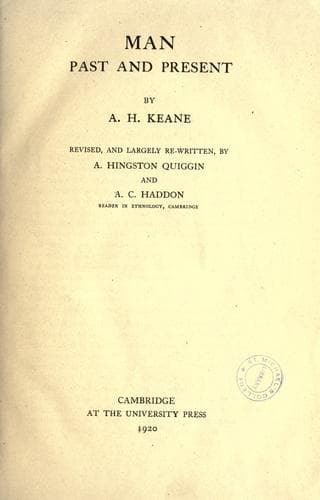
Man, Past and PresentKeane, A. H. (Augustus Henry)
History
Man, Past and Present
Keane, A. H. (Augustus Henry)
Anthropology; Ethnology
In truth there is no recognised collective name, and _Shendu_ (_Sindhu_)
often so applied is proper only to the once formidable Chittagong and
Arakan frontier tribes, _Klangklangs_ and _Hakas_, who with the _Sokte_,
_Tashons_, _Siyirs_, and others are now reduced and administered from
Falam. Each little group has its own tribal name, and often one or two
others, descriptive, abusive and so on, given them by their neighbours.
Thus the _Nwengals_ (_Nun_, river, _ngal_, across) are only that section
of the Soktes now settled on the farther or right bank of the Manipur,
while the Soktes themselves (_Sok_, to go down, _te_, men) are so called
because they migrated from Chin Nwe (9 miles from Tiddim), cradle of the
Chin race, down to Molbem, their earliest settlement, which is the
Mobingyi of the Burmese. So with Siyin, the Burmese form of _Sheyante_
(_she_, alkali, _yan_, side, _te_, men), the group who settled by the
alkali springs east of Chin Nwe, who are the _Taute_ ("stout" or
"sturdy" people) of the Lushai and southern Chins. Let these few
specimens suffice as a slight object-lesson in the involved tribal
nomenclature which prevails, not only amongst the Chins, but everywhere
in the Tibeto-Indo-Chinese domain, from the north-western Himalayas to
Cape St James at the south-eastern extremity of Farther India. I have
myself collected nearly a thousand such names of clans, septs, and
fragmentary groups within this domain, and am well aware that the list
neither is, nor ever can be, complete, the groups themselves often being
unstable quantities in a constant state of fluctuation.
Most of the Chin groups have popular legends to explain either their
origin or their present reduced state. Thus the Tawyans, a branch of the
Tashons, claim to be Torrs, that is, the people of the Rawvan district,
who were formerly very powerful, but were ruined by their insane
efforts to capture the sun. Building a sort of Jacob's ladder, they
mounted higher and higher; but growing tired, quarrelled among
themselves, and one day, while half of them were clambering up the pole,
the other half below cut it down just as they were about to seize the
sun. So the Whenohs, another Tashon group, said to be Lushais left
behind in a district now forming part of Chinland, tell a different
tale. They say they came out of the rocks at Sepi, which they think was
their original home. They share, however, this legend of their
underground origin with the Soktes and several other Chin tribes.
Public-domain text, read in full here on John Shaqi.
Reviews
Reviews
No reviews yet
Be the first to share your thoughts on this work.
Elsewhere in the archive
Join the Discussion
Join the discussion
Sign in to leave a comment or review.
Sign InorCreate an account