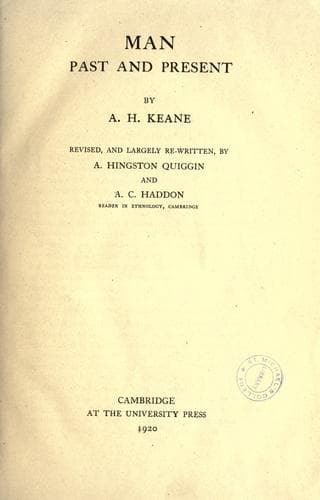
Man, Past and PresentKeane, A. H. (Augustus Henry)
History
Man, Past and Present
Keane, A. H. (Augustus Henry)
Anthropology; Ethnology
Cholera and small-pox are spirits, and when cholera broke out among the
Chins who visited Rangoon in 1895 they carried their _dahs_ (knives)
drawn to scare off the _nat_, and spent the day hiding under bushes, so
that the spirit should not find them. Some even wanted to sacrifice a
slave boy, but were talked over to substitute some pariah dogs. They
firmly believe in the evil eye, and the Hakas think the Sujins and
others are all wizards, whose single glance can bewitch them, and may
cause lizards to enter the body and devour the entrails. A Chin once
complained to Surgeon-Major Newland that a _nat_ had entered his stomach
at the glance of a Yahow, and he went to hospital quite prepared to die.
But an emetic brought him round, and he went off happy in the belief
that he had vomited the _nat_.
Ethnically connected with the Kuki-Naga groups are the _Kakhyens_ of the
Irawadi headstreams, and the _Karens_, who form numerous village
communities about the Burma-Siamese borderland. The Kakhyens, so called
abusively by the Burmese, are the _Cacobees_ of the early writers[421],
whose proper name is _Singpho_ (_Chingpaw_), i.e. "Men[422]," and whose
curious semi-agglutinating speech, spoken in an ascending tone, each
sentence ending in a long-drawn _i_ in a higher key (Bigandet), shows
affinities rather with the Mishmi and other North Assamese tongues than
with the cultured Burmese. They form a very widespread family,
stretching from the Eastern Himalayas right into Yunnan, and presenting
two somewhat marked physical types: (1) the true Chingpaws, with short
round head, low forehead, prominent cheek-bones, slant eye, broad nose,
thick protruding lips, very dark brown hair and eyes, dirty buff colour,
mean height (about 5 ft. 5 or 6 in.) with disproportionately short legs;
(2) a much finer race, with regular Caucasic features, long oval face,
pointed chin, aquiline nose. One Kakhyen belle met with at Bhamo, "with
large lustrous eyes and fair skin, might almost have passed for a
European[423]."
It is important to note this Caucasic element, which we first meet here
going eastwards from the Himalayas, but which is found either separate
or interspersed amongst the Mongoloid populations all over the
south-east Asiatic uplands from Tibet to Cochin-China, and passing
thence into Oceanica[424].
The kinship of the Kakhyens with the still more numerous Karens is now
generally accepted, and it is no longer found necessary to bring the
latter all the way from Turkestan. They form a large section, perhaps
one-sixth, of the whole population of Burma, and overflow into the west
Siamese borderlands. Their subdivisions are endless, though all may be
reduced to three main branches, _Sgaws_, _Pwos_ and _Bwais_, these last
including the somewhat distinct group of _Karenni_, or "Red Karens."
Although D. M. Smeaton calls the language "monosyllabic," it is
evidently agglutinating, of the normal sub-Himalayan type[425].
Public-domain text, read in full here on John Shaqi.
Reviews
Reviews
No reviews yet
Be the first to share your thoughts on this work.
Elsewhere in the archive
Join the Discussion
Join the discussion
Sign in to leave a comment or review.
Sign InorCreate an account