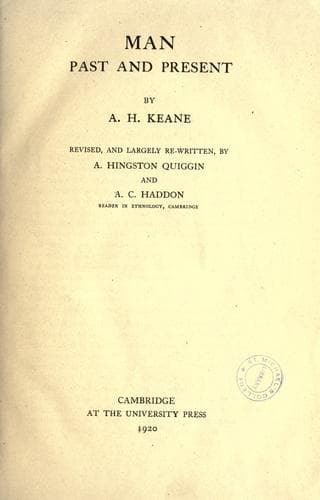
Man, Past and PresentKeane, A. H. (Augustus Henry)
History
Man, Past and Present
Keane, A. H. (Augustus Henry)
Anthropology; Ethnology
The Karens are a short, sturdy race, with straight black and also
brownish hair, black, and even hazel eyes, and light or yellowish brown
complexion, so that here also a Caucasic strain may be suspected.
Despite the favourable pictures of the missionaries, whose propaganda
has been singularly successful amongst these aborigines, the Karens are
not an amiable or particularly friendly people, but rather shy, reticent
and even surly, though trustworthy and loyal to those chiefs and guides
who have once gained their confidence. In warfare they are treacherous
rather than brave, and strangely cruel even to little children. Their
belief in a divine Creator who has deserted them resembles that of the
Kuki people, and to the _nats_ of the Kuki correspond the _la_ of the
Karens, who are even more numerous, every mountain, stream, rapid,
crest, peak or other conspicuous object having its proper indwelling
_la_. There are also seven specially baneful spirits, who have to be
appeased by family offerings. "On the whole their belief in a personal
god, their tradition as to the former possession of a 'law,' and their
expectation of a prophet have made them susceptible to Christianity to a
degree that is almost unique. Of this splendid opportunity the American
mission has taken full advantage, educating, civilising, welding
together, and making a people out of the downtrodden Karen tribes, while
Christianizing them[426]."
In the Burmese division proper are comprised several groups, presenting
all grades of culture, from the sheer savagery of the Mros, Kheongs, and
others of the Arakan Yoma range, and the agricultural Mugs of the Arakan
plains, to the dominant historical Burmese nation of the Irawadi valley.
Here also the terminology is perplexing, and it may be well to explain
that _Yoma_, applied by Logan collectively to all the Arakan Hill
tribes, has no ethnic value at all, simply meaning a mountain range in
Burmese[427]. _Toung-gnu_, one of Mason's divisions of the Burmese
family, was merely a petty state founded by a younger branch of the
Royal House, and "has no more claim to rank as a separate tribe than any
other Burman town[428]. "_Tavoyers_ are merely the people of the Tavoy
district, Tenasserim, originally from Arakan, and now speaking a Burmese
dialect largely affected by Siamese elements; _Tungthas_, like Yoma,
means "Highlander," and is even of wider application; the Tipperahs,
Mrungs, Kumi, Mros, Khemis, and Khyengs are all Tungthas of Burmese
stock, and speak rude Burmese dialects.
Public-domain text, read in full here on John Shaqi.
Reviews
Reviews
No reviews yet
Be the first to share your thoughts on this work.
Elsewhere in the archive
Join the Discussion
Join the discussion
Sign in to leave a comment or review.
Sign InorCreate an account