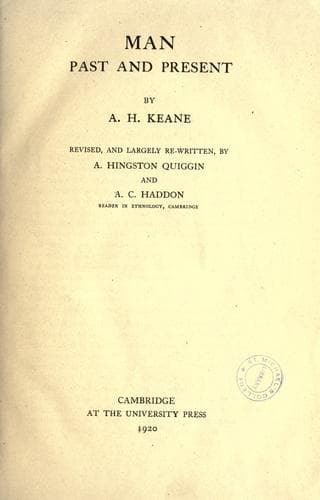
Man, Past and PresentKeane, A. H. (Augustus Henry)
History
Man, Past and Present
Keane, A. H. (Augustus Henry)
Anthropology; Ethnology
Thus in both hemispheres the iso-cultural bands follow the isothermal
lines in all their deflections, and the human varieties everywhere
faithfully reflect the conditions of their several environments.
FOOTNOTES:
[1] _Ethnology_, Chaps. V. and VII.
[2] See A. H. Keane, _Ethnology_, 1909, Chap. VII.
[3] H. Klaatsch, "Die Aurignac-Rasse und ihre Stellung im Stammbaum des
Menschen," _Ztschr. f. Eth._ LII. 1910. See also _Praehistorische
Zeitschrift_, Vol. I. 1909.
[4] Cf. A. Keith's criticisms in _Nature_, Vol. LXXXV. 1911, p. 508.
[5] W. L. H. Duckworth, _Prehistoric Man_, 1912, p. 146.
[6] W. Ridgeway, "The Influence of Environment on Man," _Journ. Roy.
Anthr. Inst._, Vol. XL. 1910, p. 10.
[7] E. Dubois, "_Pithecanthropus erectus_, transitional form between Man
and the Apes," _Sci. Trans. R. Dublin Soc._ 1898.
[8] O. Schoetensack, _Der Unterkiefer des Homo Heidelbergensis_, etc.,
1908.
[9] C. Dawson and A. Smith Woodward, "On the Discovery of a Palaeolithic
Skull and Mandible," etc., _Quart. Journ. Geol. Soc._ 1913.
[10] This was the view of A. Smith Woodward when the skull was first
exhibited (_loc. cit._), but in his paper, "Missing Links among Extinct
Animals," _Brit. Ass._ Birmingham, 1913, he is inclined to regard
"Piltdown man, or some close relative" as "on the direct line of descent
with ourselves." For A. Keith's criticism see _The Antiquity of Man_,
1915, p. 503.
[11] W. L. H. Duckworth, _Prehistoric Man_, 1912, p. 8.
[12] For the relation between chin formation and power of speech, see E.
Walkhoff, "Der Unterkiefer der Anthropomorphen und des Menschen in
seiner funktionellen Entwicklung und Gestalt," E. Selenka,
_Menschenaffen_, 1902; H. Obermaier, _Der Mensch der Vorzeit_, 1912, p.
362; and W. Wright, "The Mandible of Man from the Morphological and
Anthropological points of view," _Essays and Studies presented to W.
Ridgeway_, 1913.
[13] Cf. W. L. H. Duckworth, _Prehistoric Man_, 1912, p. 10, and A.
Keith, _The Antiquity of Man_, 1915, p. 237.
[14] A. Smith Woodward, 1070 c.c.; A. Keith, 1400 c.c.
[15] G. G. MacCurdy, following G. S. Miller, _Smithsonian Misc. Colls._
Vol. 65, No. 12 (1915), is convinced that "in place of _Eoanthropus
dawsoni_ we have two individuals belonging to different genera," a human
cranium and the jaw of a chimpanzee. _Science_, N.S. Vol. XLIII. 1916,
p. 231. See also Appendix A.
[16] For a full description see _Quart. Journ. Geol. Soc._ March, 1913.
Also A. Keith, _The Antiquity of Man_, 1915, p. 320, and pp. 430-452.
[17] C. Dawson and A. Smith Woodward, "Supplementary Note on the
Discovery of a Palaeolithic Human Skull and Mandible at Piltdown
(Sussex)," _Quart. Journ. Geol. Soc._ April, 1914.
[18] _The Antiquity of Man_, 1915, p. 209.
[19] Thus Lucretius:
"Arma antiqua manus, ungues, dentesque fuerunt,
Et lapides, et item silvarum fragmina rami."
[20] _Jour. Anthrop. Inst._ 1896, p. 133.
[21] _Inaugural Address_, Brit. Ass. Meeting, Toronto, 1897.
Public-domain text, read in full here on John Shaqi.
Reviews
Reviews
No reviews yet
Be the first to share your thoughts on this work.
Join the Discussion
Join the discussion
Sign in to leave a comment or review.
Sign InorCreate an account