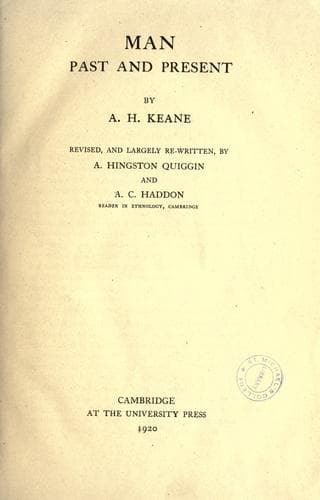
Man, Past and PresentKeane, A. H. (Augustus Henry)
History
Man, Past and Present
Keane, A. H. (Augustus Henry)
Anthropology; Ethnology
Notwithstanding their wide diffusion, interminglings with other races,
varied grades of culture, and lack of political cohesion, the Tai-Shan
groups acquire a certain ethnical and even national unity from their
generally uniform type, social usages, Buddhist religion, and common
Indo-Chinese speech. Amidst a chaos of radically distinct idioms current
amongst the surrounding indigenous populations, they have everywhere
preserved a remarkable degree of linguistic uniformity, all speaking
various more or less divergent dialects of the same mother-tongue.
Excluding a large percentage of Sanskrit terms introduced into the
literary language by their Hindu educators, this radical mother-tongue
comprises about 1860 distinct words or rather sounds, which have been
reduced by phonetic decay to so many monosyllables, each uttered with
five tones, the natural tone, two higher tones, and two lower[448]. Each
term thus acquires five distinct meanings, and in fact represents five
different words, which were phonetically distinct dissyllables, or even
polysyllables in the primitive language.
The same process of disintegration has been at work throughout the whole
of the Indo-Chinese linguistic area, where all the leading
tongues--Chinese, Annamese, Tai-Shan, Burmese--belong to the same
isolating form of speech, which, as explained in _Ethnology_, Chap. IX.,
is not a primitive condition, but a later development, the outcome of
profound phonetic corruption.
The remarkable uniformity of the Tai-Shan member of this order of speech
may be in part due to the conservative effects of the literary standard.
Probably over 2000 years ago most of the Shan groups were brought under
Hindu influences by the Brahman, and later by the Buddhist missionaries,
who reduced their rude speech to written form, while introducing a large
number of Sanskrit terms inseparable from the new religious ideas. The
writing systems, all based on the square Pali form of the Devanagari
syllabic characters, were adapted to the phonetic requirements of the
various dialects, with the result that the Tai-Shan linguistic family is
encumbered with four different scripts. "The Western Shans use one very
like the Burmese; the Siamese have a character of their own, which is
very like Pali; the Shans called Lue have another character of their own;
and to the north of Siam the Lao Shans have another[449]."
Public-domain text, read in full here on John Shaqi.
Reviews
Reviews
No reviews yet
Be the first to share your thoughts on this work.
Elsewhere in the archive
Join the Discussion
Join the discussion
Sign in to leave a comment or review.
Sign InorCreate an account