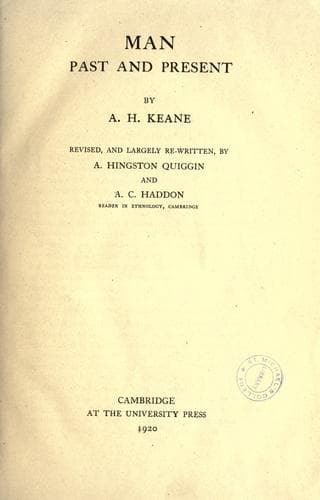
Man, Past and PresentKeane, A. H. (Augustus Henry)
History
Man, Past and Present
Keane, A. H. (Augustus Henry)
Anthropology; Ethnology
Yet the women, like their Burmese sisters, have always held a somewhat
honourable social position, being free to walk abroad, go shopping,
visit their friends, see the sights, and take part in the frequent
public feastings without restriction. Those, however, who brought no
dower and had to be purchased, might again be sold at any time, and
many thus constantly fell from the dignity of matrons to the position of
the merest drudges without rights or privileges of any kind. These
strange relations were endurable, thanks to the genial nature of the
national temperament, by which the hard lot of the thralls was softened,
and a little light allowed to penetrate into the darkest corners[461] of
the social system. The open slave-markets, which in the vassal Lao
states fostered systematic raiding-expeditions amongst the unreduced
aborigines, were abolished in 1873, and since 1890 all born in slavery
are free on reaching their 21st year.
Siamese Buddhism is a slightly modified form of that prevailing in
Ceylon, although strictly practised but by few. There are two classes or
"sects," the reformers who attach more importance to the observance of
the canon law than to meditation, and the old believers, some devoted to
a contemplative life, others to the study of the sunless wilderness of
Buddhist writings. But, beneath it all, spirit or devil-worship is still
rife, and in many districts pure animism is practically the only
religion. Even temples and shrines have been raised to the countless
gods of land and water, woods, mountains, villages and households. To
these gods are credited all sorts of calamities, and to prevent them
from getting into the bodies of the dead the latter are brought out, not
through door or window, but through a breach in the wall, which is
afterwards carefully built up. Similar ideas prevail amongst many other
peoples, both at higher and lower levels of culture, for nothing is more
ineradicable than such popular beliefs associated with the relations
presumed to exist between the present and the after life.
Incredible sums are yearly lavished in offerings to the spirits, which
give rise to an endless round of feasts and revels, and also in support
of the numerous Buddhist temples, convents, and their inmates. The
treasures accumulated in the "royal cloisters" and other shrines
represent a great part of the national savings--investments for the
other world, among which are said to be numerous gold statues glittering
with rubies, sapphires, and other priceless gems. But in these matters
the taste of the _talapoins_[462], as the priests were formerly called,
is somewhat catholic, including pictures of reviews and battle-scenes
from the European illustrated papers, and sometimes even statues of
Napoleon set up by the side of Buddha.
Public-domain text, read in full here on John Shaqi.
Reviews
Reviews
No reviews yet
Be the first to share your thoughts on this work.
Elsewhere in the archive
Join the Discussion
Join the discussion
Sign in to leave a comment or review.
Sign InorCreate an account