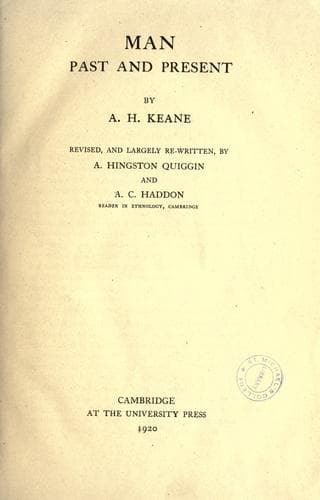
Man, Past and PresentKeane, A. H. (Augustus Henry)
History
Man, Past and Present
Keane, A. H. (Augustus Henry)
Anthropology; Ethnology
So numerous, absurd, and exacting are the rules of the monastic
communities that, but for the aid of the temple servants and novices,
existence would be impossible. A list of such puerilities occupies
several pages in A. R. Colquhoun's work _Amongst the Shans_ (219-231),
and from these we learn that the monks must not dig the ground, so that
they can neither plant nor sow; must not boil rice, as it would kill the
germ; eat corn for the same reason; climb trees lest a branch get
broken; kindle a flame, as it destroys the fuel; put out a flame, as
that also would extinguish life; forge iron, as sparks would fly out and
perish; swing their arms in walking; wink in speaking; buy or sell;
stretch the legs when sitting; breed poultry, pigs, or other animals;
mount an elephant or palanquin; wear red, black, green, or white
garments; mourn for the dead, etc., etc. In a word all might be summed
up by a general injunction neither to do anything, nor not to do
anything, and then despair of attaining _Nirvana_; for it would be
impossible to conceive of any more pessimistic system in theory[463].
Practically it is otherwise, and in point of fact the utmost religious
indifference prevails amongst all classes.
Within the Mongolic division it would be difficult to imagine any more
striking contrast than that presented by the gentle, kindly, and on the
whole not ill-favoured Siamese, and their hard-featured, hard-hearted,
and grasping Annamese neighbours. Let anyone, who may fancy there is
little or nothing in blood, pass rapidly from the bright, genial--if
somewhat listless and corrupt--social life of Bangkok to the dry,
uncongenial moral atmosphere of Ha-noi or Saigon, and he will be apt to
modify his views on that point. Few observers have a good word to say
for the Tonkingese, the Cochin-Chinese, or any other branch of the
Annamese family, and some even of the least prejudiced are so outspoken
that we must needs infer there is good ground for their severe
strictures on these strange, uncouth materialists. Buddhists of course
they are nominally; but of the moral sense they have little, unless it
be (amongst the lettered classes) a pale reflection of the pale Chinese
ethical code. The whole region in fact is a sort of attenuated China, to
which it owes its arts and industries, its letters, moral systems,
general culture, and even a large part of its inhabitants. _Giao-shi_
(_Kiao-shi_), the name of the aborigines, said to mean "Bifurcated," or
"Cross-toes[464]," in reference to the wide space between the great toe
and the next, occurs in the legendary Chinese records so far back as
2285 B.C., since which period the two countries are supposed to have
maintained almost uninterrupted relations, whether friendly or hostile,
down to the present day. At first the Giao-shi were confined to the
northern parts of Lu-kiang, the present Tonking, all the rest of the
coastlands being held by the powerful Champa (Tsiampa) people, whose
Public-domain text, read in full here on John Shaqi.
Reviews
Reviews
No reviews yet
Be the first to share your thoughts on this work.
Elsewhere in the archive
Join the Discussion
Join the discussion
Sign in to leave a comment or review.
Sign InorCreate an account