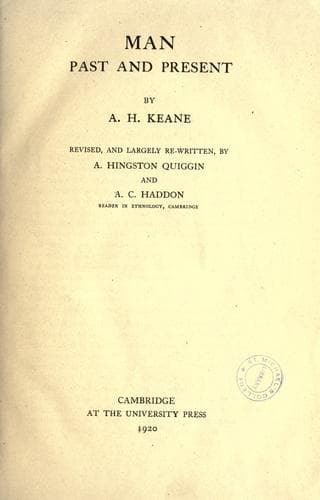
Man, Past and PresentKeane, A. H. (Augustus Henry)
History
Man, Past and Present
Keane, A. H. (Augustus Henry)
Anthropology; Ethnology
Even more than in China, the family is the true base of the social
system, the head of the household being not only the high-priest of the
ancestral cult, but also a kind of patriarch enjoying almost absolute
control over his children. In this respect the relations are somewhat
one-sided, the father having no recognised obligations towards his
offspring, while these are expected to show him perfect obedience in
life and veneration after death. Besides this worship of ancestry and
the Confucian ethical philosophy, a national form of Buddhism is
prevalent. Some even profess all three of these so-called "religions,"
beneath which there still survive many of the primitive superstitions
associated with a not yet extinct belief in spirits and the supernatural
power of magicians. While the Buddhist temples are neglected and the few
bonzes[470] despised, offerings are still made to the genii of
agriculture, of the waters, the tiger, the dolphin, peace, war,
diseases, and so forth, whose rude statues in the form of dragons or
other fabulous monsters are even set up in the pagodas. Since the early
part of the seventeenth century Roman Catholic missionaries have
laboured with considerable success in this unpromising field, where the
congregations were estimated in 1898 at about 900,000.
From Annam the ethnical transition is easy to China[471] and its teeming
multitudes, regarding whose origins, racial and cultural, two opposite
views at present hold the field. What may be called the old, but by no
means the obsolete school, regards the Chinese populations as the direct
descendants of the aborigines who during the Stone Ages entered the
Hoang-ho valley probably from the Tibetan plateau, there developed their
peculiar culture independently of foreign influences, and thence spread
gradually southwards to the whole of China proper, extirpating,
absorbing, or driving to the encircling western and southern uplands the
ruder aborigines of the Yang-tse-Kiang and Si-Kiang basins.
In direct opposition to this view the new school, championed especially
by T. de Lacouperie[472], holds that the present inhabitants of China
are late intruders from south-western Asia, and that they arrived not as
rude aborigines, but as a cultured people with a considerable knowledge
of letters, science, and the arts, all of which they acquired either
directly or indirectly from the civilised Akkado-Sumerian inhabitants of
Babylonia.
Public-domain text, read in full here on John Shaqi.
Reviews
Reviews
No reviews yet
Be the first to share your thoughts on this work.
Elsewhere in the archive
Join the Discussion
Join the discussion
Sign in to leave a comment or review.
Sign InorCreate an account