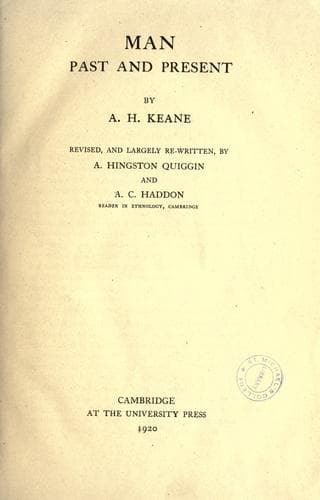
Man, Past and PresentKeane, A. H. (Augustus Henry)
History
Man, Past and Present
Keane, A. H. (Augustus Henry)
Anthropology; Ethnology
Yet they have one redeeming quality, an intense love of personal
freedom, strangely contrasting with the almost abject slavish spirit of
the Siamese. The feeling extends to all classes, so that servitude is
held in abhorrence, and, as in Burma, a democratic sense of equality
permeates the social system[469]. Hence, although the State has always
been an absolute monarchy, each separate commune constitutes a veritable
little oligarchic commonwealth. This has come as a great surprise to the
present French administrators of the country, who frankly declare that
they cannot hope to improve the social or political position of the
people by substituting European for native laws and usages. The Annamese
have in fact little to learn from western social institutions.
Their language, spoken everywhere with remarkable uniformity, is of the
normal Indo-Chinese isolating type, possessing six tones, three high,
and three low, and written in ideographic characters based on the
Chinese, but with numerous modifications and additions. But, although
these are ill-suited for the purpose, the attempt made by the early
Portuguese missionaries to substitute the so-called _quoc-ngu_, or Roman
phonetic system, has been defeated by the conservative spirit of the
people. Primary instruction has long been widely diffused, and almost
everybody can read and write as many of the numerous hieroglyphs as are
needed for the ordinary purpose of daily intercourse. Every village has
its free school, and a higher range of studies is encouraged by the
public examinations to which, as in China, all candidates for government
appointments are subjected. Under such a scheme surprising results might
be achieved, were the course of studies not based exclusively on the
empty formulas of Chinese classical literature. The subjects taught are
for the most part puerile, and true science is replaced by the dry moral
precepts of Confucius. One result amongst the educated classes is a
scoffing, sceptical spirit, free from all religious prejudice, and
unhampered by theological creeds or dogmas, combined with a lofty moral
tone, not always however in harmony with daily conduct.
Public-domain text, read in full here on John Shaqi.
Reviews
Reviews
No reviews yet
Be the first to share your thoughts on this work.
Elsewhere in the archive
Join the Discussion
Join the discussion
Sign in to leave a comment or review.
Sign InorCreate an account