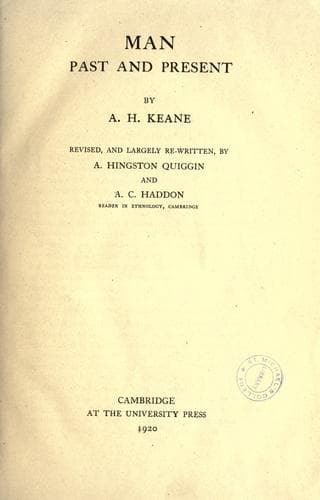
Man, Past and PresentKeane, A. H. (Augustus Henry)
History
Man, Past and Present
Keane, A. H. (Augustus Henry)
Anthropology; Ethnology
Hence the linguistic argument seems to fail completely, while the
Babylonian origin of the Chinese writing system, or rather, the
derivation of Chinese and Sumerian from some common parent in Central
Asia, awaits further evidence. Many of the Chinese and Akkadian "line
forms" collated by C. J. Ball[475] are so simple and, one might say,
obvious, that they seem to prove nothing. They may be compared with such
infantile utterances as _pa_, _ma_, _da_, _ta_, occurring in half the
languages of the world, without proving a connection or affinity between
any of them. But even were the common origin of the two scripts
established, it would prove nothing as to the common origin of the two
peoples, but only show cultural influences, which need not be denied.
But if Chinese origins cannot be clearly traced back to Babylonia,
Chinese culture may still, in a sense, claim to be the oldest in the
world, inasmuch as it has persisted with little change from its rise
some 4500 years ago down to present times. All other early
civilisations--Mesopotamian, Egyptian, Assyrian, Persian,
Hellenic--have perished, or live only in their monuments, traditions,
oral or written records. But the Chinese, despite repeated political and
social convulsions, is still as deeply rooted in the past as ever,
showing no break of continuity from the dim echoes of remote prehistoric
ages down to the last revolution, and the establishment of the Republic.
These things touch the surface only of the great ocean of Chinese
humanity, which is held together, not by any general spirit of national
sentiment (all sentiment is alien from the Chinese temperament), nor by
any community of speech, for many of the provincial dialects differ
profoundly from each other, but by a prodigious power of inertia, which
has hitherto resisted all attempts at change either by pressure from
without, or by spontaneous impulse from within.
What they were thousands of years ago, the Chinese still are, a frugal,
peace-loving, hard-working people, occupied mainly with tillage and
trade, cultivating few arts beyond weaving, porcelain and metal work,
but with a widely diffused knowledge of letters, and a writing system
which still remains at the cumbrous ideographic stage, needing as many
different symbols as there are distinct concepts to be expressed. Yet
the system has one advantage, enabling those who speak mutually
unintelligible idioms to converse together, using the pencil instead of
the tongue. For this very reason the attempts made centuries ago by the
government to substitute a phonetic script had to be abandoned. It was
found that imperial edicts and other documents so written could not be
understood by the populations speaking dialects different from the
literary standard, whereas the hieroglyphs, like our ciphers 1, 2,
3 ..., could be read by all educated persons of whatever allied form of
speech.
Public-domain text, read in full here on John Shaqi.
Reviews
Reviews
No reviews yet
Be the first to share your thoughts on this work.
Elsewhere in the archive
Join the Discussion
Join the discussion
Sign in to leave a comment or review.
Sign InorCreate an account