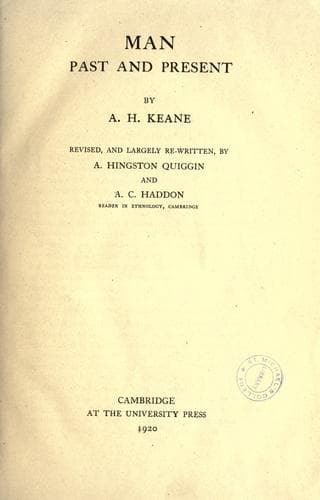
Man, Past and PresentKeane, A. H. (Augustus Henry)
History
Man, Past and Present
Keane, A. H. (Augustus Henry)
Anthropology; Ethnology
Originally the Chinese system, whether developed on the spot or derived
from Akkadian or any other foreign source, was of course pictographic or
ideographic, and it is commonly supposed to have remained at that stage
ever since, the only material changes being of a graphic nature. The
pictographs were conventionalised and reduced to their present form, but
still remained ideograms supplemented by a limited number of phonetic
determinants. But de Lacouperie has shown that this view is a mistake,
and that the evolution from the pictograph to the phonetic symbol had
been practically completed in China many centuries before the new era.
The _Ku-wen_ style current before the ninth century B.C. "was really
the phonetic expression of speech[476]." But for the reason stated it
had to be discontinued, and a return made to the earlier ideographic
style. The change was effected about 820 B.C. by She Choeu, minister of
the Emperor Sueen Wang, who introduced the _Ta-chuen_ style in which "he
tried to speak to the eye and no longer to the ear," that is, he
reverted to the earlier ideographic process, which has since prevailed.
It was simplified about 227 B.C. (_Siao Chuen_ style), and after some
other modifications the present caligraphic form (_Kiai Shu_) was
introduced by Wang Hi in 350 A.D. Thus one consequence of the "Expansion
of China" was a reversion to barbarism, in respect at least of the
national graphic system, by which Chinese thought and literature have
been hampered for nearly 3000 years.
Written records, though at first mainly of a mythical character, date
from about 3000 B.C.[477] Reference is made in the early documents to
the rude and savage times, which in China as elsewhere certainly
preceded the historic period. Three different prehistoric ages are even
discriminated, and tradition relates how Fu-hi introduced wooden,
Thin-ming stone, and Shi-yu metal implements[478]. Later, when their
origin and use were forgotten, the jade axes, like those from Yunnan,
were looked on as bolts hurled to the earth by the god of thunder, while
the arrow-heads, supposed to be also of divine origin, were endowed in
the popular fancy with special virtues and even regarded as emblems of
sovereignty. Thus may perhaps be explained the curious fact that in
early times, before the twelfth century B.C., tribute in flint weapons
was paid to the imperial government by some of the reduced wild tribes
of the western uplands.
Public-domain text, read in full here on John Shaqi.
Reviews
Reviews
No reviews yet
Be the first to share your thoughts on this work.
Elsewhere in the archive
Join the Discussion
Join the discussion
Sign in to leave a comment or review.
Sign InorCreate an account