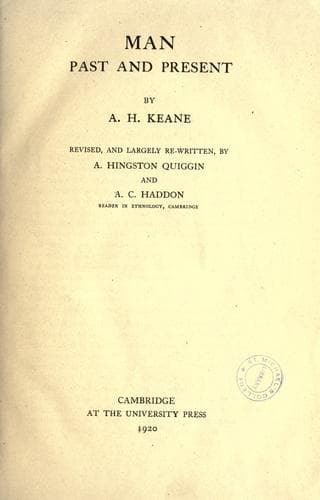
Man, Past and PresentKeane, A. H. (Augustus Henry)
History
Man, Past and Present
Keane, A. H. (Augustus Henry)
Anthropology; Ethnology
In fact appearance, outward show, observance of the "eleventh
commandment," in a word "face" as it is called, is everything in China.
"To understand, however imperfectly, what is meant by 'face,' we must
take account of the fact that as a race the Chinese have a strong
dramatic instinct. Upon very slight provocation any Chinese regards
himself in the light of an actor in a drama. A Chinese thinks in
theatrical terms. If his troubles are adjusted he speaks of himself as
having 'got off the stage' with credit, and if they are not adjusted he
finds no way to 'retire from the stage.' The question is never of facts,
but always of form. Once rightly apprehended, 'face' will be found to be
in itself a key to the combination-lock of many of the most important
characteristics of the Chinese[487]."
Of foreign religions Islam, next to Buddhism, has made most progress.
Introduced by the early Arab and Persian traders, and zealously preached
throughout the Jagatai empire in the twelfth century, it has secured a
firm footing especially in Kan-su, Shen-si, and Yunnan, and is of course
dominant in Eastern (Chinese) Turkestan. Despite the wholesale
butcheries that followed the repeated insurrections between 1855 and
1877, the _Hoei-Hoei_, _Panthays_, or _Dungans_, as the Muhammadans are
variously called, were still estimated, in 1898, at about 22,000,000 in
the whole empire.
Islam was preceded by Christianity, which, as attested by the authentic
inscription of Si-ngan-fu, penetrated into the western provinces under
the form of Nestorianism about the seventh century. The famous Roman
Catholic missions with headquarters at Pekin date from the close of the
sixteenth century, and despite internal dissensions have had a fair
measure of success, the congregations comprising altogether over one
million members. Protestant missions date from 1807 (London Missionary
Society) and in 1910 claimed over 200,000 church members and baptized
Christians, the total having more than doubled since 1900[488].
The above-mentioned dissensions arose out of the practices associated
with ancestry worship, offerings of flowers, fruits and so forth, which
the Jesuits regarded merely as proofs of filial devotion, but were
denounced by the Dominicans as acts of idolatry. After many years of
idle controversy, the question was at last decided against the Jesuits
by Clement XI in the famous Bull, _Ex illa die_ (1715), and since then,
neophytes having to renounce the national cult of their forefathers,
conversions have mainly been confined to the lower classes, too humble
to boast of any family tree, or too poor to commemorate the dead by
ever-recurring costly sepulchral rites.
Public-domain text, read in full here on John Shaqi.
Reviews
Reviews
No reviews yet
Be the first to share your thoughts on this work.
Elsewhere in the archive
Join the Discussion
Join the discussion
Sign in to leave a comment or review.
Sign InorCreate an account