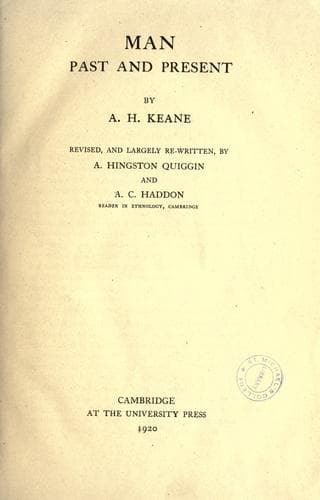
Man, Past and PresentKeane, A. H. (Augustus Henry)
History
Man, Past and Present
Keane, A. H. (Augustus Henry)
Anthropology; Ethnology
In China there are no hereditary nobles, indeed no nobles at all, unless
it be the rather numerous descendants of Confucius who dwell together
and enjoy certain social privileges, in this somewhat resembling the
_Shorfa_ (descendants of the Prophet) in Muhammadan lands. If any titles
have to be awarded for great deeds they fall, not on the hero, but on
his forefathers, and thus at a stroke of the vermilion pencil are
ennobled countless past generations, while the last of the line remains
unhonoured until he goes over to the majority. Between the Emperor,
"patriarch of his people," and the people themselves, however, there
stood an aristocracy of talent, or at least of Chinese scholarship, the
governing Mandarin[489] class, which was open to the highest and the
lowest alike. All nominations to office were conferred exclusively on
the successful competitors at the public examinations, so that, like the
French conscript with the hypothetical Marshal's baton in his knapsack,
every Chinese citizen carried the buttoned cap of official rank in his
capacious sleeve. Of these there are nine grades, indicated respectively
in descending order by the ruby, red coral, sapphire, opaque blue,
crystal, white shell, gold (two), and silver button, or rather little
globe, on the cap of office, with which correspond the nine
birds--manchu crane, golden pheasant, peacock, wild goose, silver
pheasant, egret, mandarin duck, quail, and jay--embroidered on the
breast and back of the State robe.
Theoretically the system is admirable, and at all events is better than
appointments by Court favour. But in practice it was vitiated, first by
the narrow, antiquated course of studies in the dry Chinese classics,
calculated to produce pedants rather than statesmen, and secondly by the
monopoly of preference which it conferred on a lettered caste to the
exclusion of men of action, vigour, and enterprise. Moreover,
appointments being made for life, barring crime or blunder, the
Mandarins, as long as they approved themselves zealous supporters of the
reigning dynasty, enjoyed a free hand in amassing wealth by plunder, and
the wealth thus acquired was used to purchase further promotion and
advancement, rather than to improve the welfare of the people.
Public-domain text, read in full here on John Shaqi.
Reviews
Reviews
No reviews yet
Be the first to share your thoughts on this work.
Elsewhere in the archive
Join the Discussion
Join the discussion
Sign in to leave a comment or review.
Sign InorCreate an account