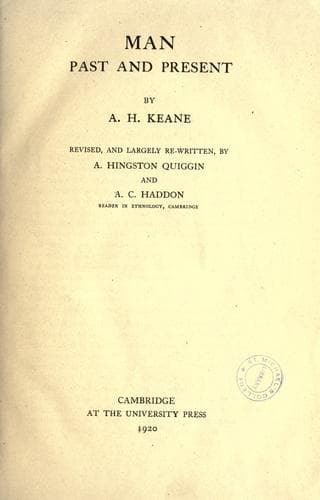
Man, Past and PresentKeane, A. H. (Augustus Henry)
History
Man, Past and Present
Keane, A. H. (Augustus Henry)
Anthropology; Ethnology
[406] Almost hopeless confusion continues to prevail in the tribal
nomenclature of these multitudinous hill peoples. The official sanction
given to the terms _Kuki_ and _Lushai_ as collective names may be
regretted, but seems now past remedy. _Kuki_ is unknown to the people
themselves, while _Lushai_ is only the name of a single group proud of
their head-hunting proclivities, hence they call themselves, or perhaps
are called _Lu-Shai_, "Head-Cutters," from _lu_ head, _sha_ to cut (G.
H. Damant). Other explanations suggested by C. A. Soppitt (_Kuki-Lushai
Tribes, with an Outline Grammar of the Rangkhol-Lushai Language_,
Shillong, 1887) cannot be accepted.
[407] _Op. cit._
[408] See G. A. Grierson and Sten Konow in Grierson's _Linguistic Survey
of India_, Vol. III. Part II. Bodo, N[=a]g[=a] and Kachin, 1903, Part
III. Kuki-Chin and Burma, 1904.
[409] _The N[=a]ga Tribes of Manipur_, 1911, p. 2. Cf. J. Shakespear,
"The Kuki-Lushai Clans," _Journ. Roy. Anthr. Inst._ XXXIX. 1909.
[410] _Op. cit. p. 5._
[411] _Op. cit._ p. 122. A custom of human sacrifice among the Naga is
described in the _Journal of the Burma Research Society_, 1911, "Human
Sacrifices near the Upper Chindwin."
[412] It is a curious phonetic phenomenon that the combinations _kl_ and
_tl_ are indistinguishable in utterance, so that it is immaterial
whether this term be written _Kling_ or _Tling_, though the latter form
would be preferable, as showing its origin from _Telinga_.
[413] "The Aboriginal Tribes of Manipur," _Journ. Anthr. Inst._ 1887, p.
350.
[414] R. Brown, _Statistical Account of Manipur_, 1874.
[415] T. C. Hodson, _The Meitheis_, 1908, p. 96.
[416] T. C. Hodson, _The Meitheis_, 1908, pp. 96-7.
[417] G. Watt, _loc. cit._ p. 362.
[418] _The Chin Hills_, etc., Vol. I., Rangoon, 1896.
[419] _Op. cit._ p. 165.
[420] R. C. Temple, Art. "Burma," Hastings, _Ency. Religion and Ethics_,
1910.
[421] Dalton, _Ethnology of Bengal_, p. 9.
[422] Prince Henri d'Orleans writes "que les Singphos et les Katchins
[Kakhyens] ne font qu'un, que le premier mot est _thai_ et le second
birman." _Du Tonkin aux Indes_, 1898, p. 311. This is how the ethnical
confusion in these borderlands gets perpetuated. _Singpho_ is not
_Thai_, i.e. Shan or Siamese, but a native word as here explained.
[423] John Anderson, _Mandalay to Momein_, 1876, p. 131.
[424] Three skulls discovered by M. Mansuy in a cave at Pho-Binh-Gia
(Indo-China) associated with Neolithic culture were markedly
dolichocephalic, resembling in some respects the Cro-Magnon race of the
Reindeer period. Cf. R. Verneau, _L'Anthropologie_, XX. 1909.
[425] _The Loyal Karens of Burma_, 1887.
[426] R. C. Temple, _Academy_, Jan. 29, 1887, p. 72.
[427] Forbes, _Languages of Further India_, p. 61.
[428] _Ibid._ p. 55.
[429] G. W. Bird, _Wanderings in Burma_, 1897, p. 335.
Public-domain text, read in full here on John Shaqi.
Reviews
Reviews
No reviews yet
Be the first to share your thoughts on this work.
Elsewhere in the archive
Join the Discussion
Join the discussion
Sign in to leave a comment or review.
Sign InorCreate an account