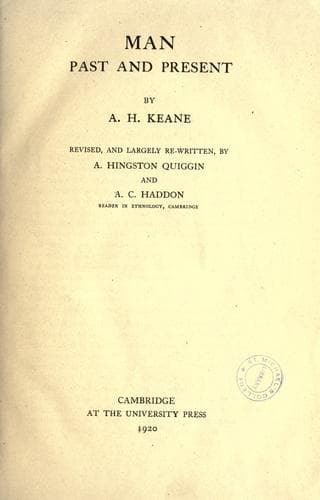
Man, Past and PresentKeane, A. H. (Augustus Henry)
History
Man, Past and Present
Keane, A. H. (Augustus Henry)
Anthropology; Ethnology
[456] With regard to _Man_ (_Man-tse_) it should be explained that in
Chinese it means "untameable worms," that is, _wild_ or _barbarous_, and
we are warned by Desgodins that "il ne faut pas prendre ces mots comme
des noms propres de tribus" (_Bul. Soc. Geogr._ XII. p. 410). In 1877
Capt. W. Gill visited a large nation of _Man-tse_ with 18 tribal
divisions, reaching from West Yunnan to the extreme north of Sechuen, a
sort of federacy recognising a king, with Chinese habits and dress, but
speaking a language resembling Sanskrit (?). These were the _Sumu_, or
"White Man-tse," apparently the same as those visited in 1896 by Mrs
Bishop, and by her described as semi-independent, ruled by their own
chiefs, and in appearance "quite Caucasian, both men and women being
very handsome," strict Buddhists, friendly and hospitable, and living in
large stone houses (Letter to _Times_, Aug. 18, 1896).
[457] "Des paysannes nongs dont les cheveux etaient blonds, quelquefois
meme roux." _Op. cit._
[458] _L'Anthropologie_, 1896, p. 602 sq.
[459] "On the Relations of the Indo-Chinese and Inter-Oceanic Races and
Languages." Paper read at the Meeting of the Brit. Association,
Sheffield, 1879, and printed in the _Journ. Anthr. Inst._, February,
1880.
[460] In the Javanese annals the invaders are called "Cambojans," but at
this time (about 1340) Camboja had already been reduced, and the Siamese
conquerors had brought back from its renowned capital, Angkor Wat, over
90,000 captives. These were largely employed in the wars of the period,
which were thus attributed to Camboja instead of to Siam by foreign
peoples ignorant of the changed relations in Indo-China.
[461] How very dark some of these corners can be may be seen from the
sad picture of maladministration, vice, and corruption still prevalent
so late as 1890, given by Hallett in _A Thousand Miles on an Elephant_,
Ch. xxxv.; and even still later by H. Warington Smyth in _Five Years in
Siam, from 1891 to 1896_ (1898). This observer credits the Siamese with
an undeveloped sense of right and wrong, so that they are good only by
accident. "To do a thing because it is right is beyond them; to abstain
from a thing because it is against their good name, or involves serious
consequences, is possibly within the power of a few; the question of
right and wrong does not enter the calculation." But he thinks they may
possess a high degree of intelligence, and mentions the case of a
peasant, who from an atlas had taught himself geography and politics. P.
A. Thompson, _Lotus Land_, 1906, gives an account of the country and
people of Southern Siam.
[462] Probably a corruption of _talapat_, the name of the palm-tree
which yields the fan-leaf constantly used by the monks.
Public-domain text, read in full here on John Shaqi.
Reviews
Reviews
No reviews yet
Be the first to share your thoughts on this work.
Elsewhere in the archive
Join the Discussion
Join the discussion
Sign in to leave a comment or review.
Sign InorCreate an account