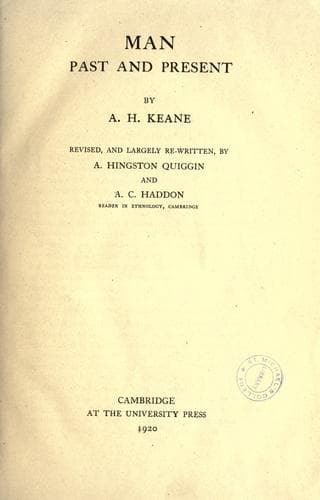
Man, Past and PresentKeane, A. H. (Augustus Henry)
History
Man, Past and Present
Keane, A. H. (Augustus Henry)
Anthropology; Ethnology
[463] "In conversation with the monks M'Gilvary was told that it would
most likely be countless ages before they would attain the much wished
for state of Nirvana, and that one transgression at any time might
relegate them to the lowest hell to begin again their melancholy
pilgrimage" (Hallett, _A Thousand Miles on an Elephant_, p. 337).
[464] "Le gros orteil est tres developpe et ecarte des autres doigts du
pied. A ce caractere distinctif, que l'on retrouve encore aujourd'hui
chez les indigenes de race pure, on peut reconnaitre facilement que les
Giao-chi sont les ancetres des Annamites" (_La Cochinchine francaise en
1878_, p. 231). See also a note on the subject by C. F. Tremlett in
_Journ. Anthr. Inst._ 1879, p. 460.
[465] Properly _An-nan_, a modified form of _ngan-nan_, "Southern
Peace."
[466] Cf. _Nan-king_, _Pe-king_, "Southern" and "Northern" Courts
(Capitals).
[467] _La Gazette Geographique_, March 12, 1885.
[468] _Geogr. Journ._, Sept. 1893, p. 194.
[469] "Parmi les citoyens regne la plus parfaite egalite. Point
d'esclavage, la servitude est en horreur. Aussi tout homme peut-il
aspirer aux emplois, se plaindre aux memes tribunaux que son adversaire"
(_op. cit._ p. 6).
[470] From _bonzo_, a Portuguese corruption of the Japanese _busso_, a
devout person, applied first to the Buddhist priests of Japan, and then
extended to those of China and neighbouring lands.
[471] This name, probably the Chinese _jin_, men, people, already occurs
in Sanskrit writings in its present form: [Sanskrit symbol], _China_,
whence the Hindi [Arabic symbol], _Chin_, and the Arabo-Persian [Arabic
symbol], _Sin_, which gives the classical _Sinae_. The most common
national name is Chung-kue, "middle kingdom" (presumably the centre of
the universe), whence Chung-kue-Jin, the Chinese people. Some have
referred _China_ to the _Chin_ (_Tsin_) dynasty (909 B.C.), while Marco
Polo's _Kataia_ (Russian _Kitai_) is the _Khata_ (North China) of the
Mongol period, from the Manchu _K'i-tan_, founders of the Liao dynasty,
which was overthrown 1115 A.D. by the Nue-Ch[)a]n Tatars. Ptolemy's
_Thinae_ is rightly regarded by Edkins as the same word as _Sinae_, the
substitution of t for s being normal in Annam, whence this form may have
reached the west through the southern seaport of Kattigara.
[472] _Western Origin of the Early Chinese Civilization, from 2300 B.C.
to 200 A.D., or Chapters on the Elements Derived from the Old
Civilizations of West Asia in the Formation of the Ancient Chinese
Culture_, London, 1894.
[473] "Observations upon the Languages of the Early Inhabitants of
Mesopotamia," in _Journ. R. As. Soc._ XVI. Part 2.
[474] MS. note, May 7, 1896.
[475] C. J. Ball, _Chinese and Sumerian_, 1913.
[476] _History of the Archaic Chinese Writing and Texts_, 1882, p. 5.
Public-domain text, read in full here on John Shaqi.
Reviews
Reviews
No reviews yet
Be the first to share your thoughts on this work.
Elsewhere in the archive
Join the Discussion
Join the discussion
Sign in to leave a comment or review.
Sign InorCreate an account