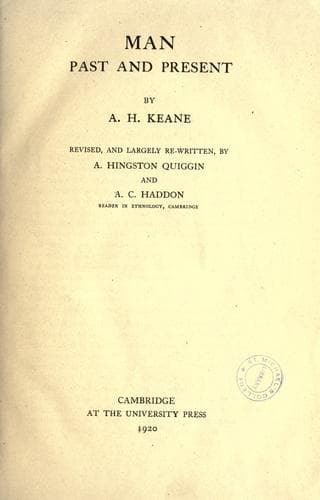
Man, Past and PresentKeane, A. H. (Augustus Henry)
History
Man, Past and Present
Keane, A. H. (Augustus Henry)
Anthropology; Ethnology
with the Siamese as "Sam-Sams," partly Buddhists, partly Muhammadans;
round the coast of Borneo and about the estuaries of that island; in
Tidor, Ternate, and the adjacent coast of Jilolo; in the Banda, Sula,
and Sulu groups; in Batavia, Singapore, and all the other large seaports
of the Archipelago. In all these lands beyond Sumatra the Orang-Malayu
are thus seen to be comparatively recent arrivals[497], and in fact
intruders on the other Malayan populations, with whom they collectively
constitute the Oceanic branch of the Mongol division. Their diffusion
was everywhere brought about much in the same way as in Ternate, where
A. R. Wallace tells us that the ruling people "are an intrusive Malay
race somewhat allied to the Macassar people, who settled in the country
at a very early epoch, drove out the indigenes, who were no doubt the
same as those of the adjacent island of Gilolo, and established a
monarchy. They perhaps obtained many of their wives from the natives,
which will account for the extraordinary language they speak--in some
respects closely allied to that of the natives of Gilolo, while it
contains much that points to a Malayan [Malay] origin. To most of these
people the Malay language is quite unintelligible[498]."
The Malayan populations, as distinguished from the Malays proper, form
socially two very distinct classes--the _Orang Benua_, "Men of the
Soil," rude aborigines, numerous especially in the interior of the Malay
Peninsula, Borneo, Celebes, Jilolo, Timor, Ceram, the Philippines,
Formosa, and Madagascar; and the cultured peoples, formerly Hindus but
now mostly Muhammadans, who have long been constituted in large
communities and nationalities with historical records, and flourishing
arts and industries. They speak cultivated languages of the Austronesian
family, generally much better preserved and of richer grammatical
structure than the simplified modern speech of the Orang-Malayu. Such
are the Achinese, Rejangs, and Passumahs of Sumatra; the Bugis,
Mangkassaras and some Minahasans of Celebes[499]; the Tagalogs and
Visayas of the Philippines; the Sassaks and Balinese of Lombok and Bali
(most of these still Hindus); the Madurese and Javanese proper of Java;
and the Hovas of Madagascar. To call any of these "Malays[500]," is like
calling the Italians "French," or the Germans "English," because of
their respective Romance and Teutonic connections.
Public-domain text, read in full here on John Shaqi.
Reviews
Reviews
No reviews yet
Be the first to share your thoughts on this work.
Elsewhere in the archive
Join the Discussion
Join the discussion
Sign in to leave a comment or review.
Sign InorCreate an account