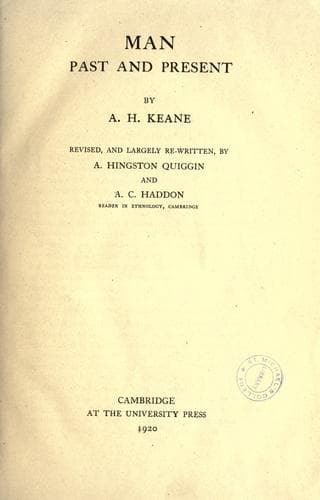
Man, Past and PresentKeane, A. H. (Augustus Henry)
History
Man, Past and Present
Keane, A. H. (Augustus Henry)
Anthropology; Ethnology
Preeminent in many respects amongst all the Malayan peoples are the
_Javanese_--_Sundanese_ in the west, _Javanese proper_ in the centre,
_Madurese_ in the east--who were a highly civilised nation while the
Sumatran Malays were still savages, perhaps head-hunters and cannibals
like the neighbouring Battas. Although now almost exclusively
Muhammadans, they had already adopted some form of Hinduism probably
over 2000 years ago, and under the guidance of their Indian teachers had
rapidly developed a very advanced state of culture. "Under a completely
organised although despotic government, the arts of peace and war were
brought to considerable perfection, and the natives of Java became
famous throughout the East as accomplished musicians and workers in
gold, iron and copper, none of which metals were found in the island
itself. They possessed a regular calendar with astronomical eras, and a
metrical literature, in which, however, history was inextricably blended
with romance. Bronze and stone inscriptions in the Kavi, or old Javanese
language, still survive from the eleventh or twelfth century, and to the
same dates may be referred the vast ruins of Brambanam and the
stupendous temple of Boro-budor in the centre of the island. There are
few statues of Hindu divinities in this temple, but many are found in
its immediate vicinity, and from the various archaeological objects
collected in the district it is evident that both the Buddhist and
Brahmanical forms of Hinduism were introduced at an early date.
"But all came to an end by the overthrow of the chief Hindu power in
1478, after which event Islam spread rapidly over the whole of Java and
Madura. Brahmanism, however, still holds its ground in Bali and Lombok,
the last strongholds of Hinduism in the Eastern Archipelago[501]."
On the obscure religious and social relations in these Lesser Sundanese
Islands much light has been thrown by Capt. W. Cool, an English
translation of whose work _With the Dutch in the East_ was issued by E.
J. Taylor in 1897. Here it is shown how Hinduism, formerly dominant
throughout a great part of Malaysia, gradually yielded in some places to
a revival of the never extinct primitive nature-worship, in others to
the spread of Islam, which in Bali alone failed to gain a footing. In
this island a curious mingling of Buddhist and Brahmanical forms with
the primordial heathendom not only persisted, but was strong enough to
acquire the political ascendancy over the Mussulman Sassaks of the
neighbouring island of Lombok. Thus while Islam reigns exclusively in
Java--formerly the chief domain of Hinduism in the Archipelago--Bali,
Lombok, and even Sumbawa, present the strange spectacle of large
communities professing every form of belief, from the grossest
heathendom to pure monotheism.
Public-domain text, read in full here on John Shaqi.
Reviews
Reviews
No reviews yet
Be the first to share your thoughts on this work.
Elsewhere in the archive
Join the Discussion
Join the discussion
Sign in to leave a comment or review.
Sign InorCreate an account