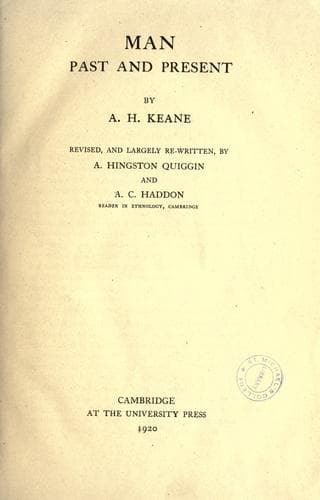
Man, Past and PresentKeane, A. H. (Augustus Henry)
History
Man, Past and Present
Keane, A. H. (Augustus Henry)
Anthropology; Ethnology
As I have elsewhere pointed out[502], it is the same with the cultures
and general social conditions, which show an almost unbroken transition
from the savagery of Sumbawa to the relative degrees of refinement
reached by the natives of Lombok and especially of Bali. Here, however,
owing to the unfavourable political relations, a retrograde movement is
perceptible in the crumbling temples, grass-grown highways, and
neglected homesteads. But it is everywhere evident enough that "just as
Hinduism has only touched the outer surface of their religion, it has
failed to penetrate into their social institutions, which, like their
gods, originate from the time when Polynesian heathendom was all
powerful[503]."
A striking illustration of the vitality of the early beliefs is
presented by the local traditions, which relate how these foreign gods
installed themselves in the Lesser Sundanese Islands after their
expulsion from Java by the Muhammadans in the fifteenth century. Being
greatly incensed at the introduction of the Koran, and also anxious to
avoid contact with the "foreign devils," the Hindu deities moved
eastwards with the intention of setting up their throne in Bali. But
Bali already possessed its own gods, the wicked Rakshasas, who fiercely
resented the intrusion, but in the struggle that ensued were
annihilated, all but the still reigning Mraya Dewana. Then the new
thrones had to be erected on heights, as in Java; but at that time there
were no mountains in Bali, which was a very flat country. So the
difficulty was overcome by bodily transferring the four hills at the
eastern extremity of Java to the neighbouring island. Gunong Agong,
highest of the four, was set down in the east, and became the Olympus of
Bali, while the other three were planted in the west, south, and north,
and assigned to the different gods according to their respective ranks.
Thus were at once explained the local theogony and the present physical
features of the island.
Public-domain text, read in full here on John Shaqi.
Reviews
Reviews
No reviews yet
Be the first to share your thoughts on this work.
Elsewhere in the archive
Join the Discussion
Join the discussion
Sign in to leave a comment or review.
Sign InorCreate an account