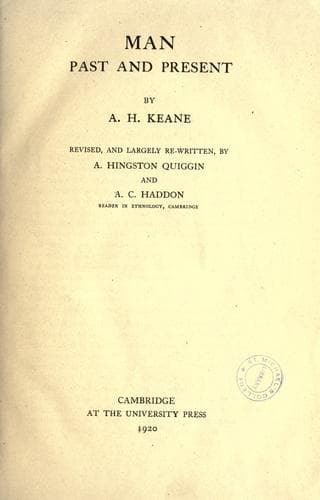
Man, Past and PresentKeane, A. H. (Augustus Henry)
History
Man, Past and Present
Keane, A. H. (Augustus Henry)
Anthropology; Ethnology
This view is also in conformity with the character of the numerous
Formosan dialects, whose affinities are either with the Gyarung and
others of the Asiatic Indonesian tongues, or else with the Austronesian
organic speech generally, but not specially with any particular member
of that family, least of all with the comparatively recent standard
Malay. Thus Arnold Schetelig points out that only about a sixth part of
the Formosan vocabulary taken generally corresponds with modern
Malay[564]. The analogies of all the rest must be sought in the various
branches of the Oceanic stock language, and in the Gyarung and the
non-Chinese tongues of Eastern China[565]. Formosa thus presents a
curious ethnical and linguistic connecting link between the Continental
and Oceanic populations.
In the Nicobar archipelago are distinguished two ethnical groups, the
coast people, _i.e._ the _Nicobarese_[566] proper, and the _Shom Pen_,
aborigines of the less accessible inland districts in Great Nicobar. But
the distinction appears to be rather social than racial, and we may now
conclude with E. H. Man that all the islanders belong essentially to the
Mongolic division, the inlanders representing the pure type, the others
being "descended from a mongrel Malay stock, the crosses being probably
in the majority of cases with Burmese and occasionally with natives of
the opposite coast of Siam, and perchance also in remote times with such
of the Shom Pen as may have settled in their midst[567]."
Among the numerous usages which point to an Indo-Chinese and Oceanic
connection are pile-dwellings; the chewing of betel, which appears to be
here mixed with some earthy substance causing a dental incrustation so
thick as even to prevent the closing of the lips; distention of the
ear-lobe by wooden cylinders; aversion from the use of milk; and the
_couvade_, as amongst some Bornean Dayaks. The language, which has an
extraordinarily rich phonetic system (as many as 25 consonantal and 35
vowel sounds), is polysyllabic and untoned, like the Austronesian, and
the type also seems to resemble the Oceanic more than the Continental
Mongol subdivision. Mean height 5 ft. 3 in. (Shom Pen one inch less);
nose wide and flat; eyes rather obliquely set; cheekbones prominent;
features flat, though less so than in the normal Malayan; complexion
mostly a yellowish or reddish brown (Shom Pen dull brown); hair a dark
rusty brown, rarely quite black, straight, though not seldom wavy and
even ringletty, but Shom Pen generally quite straight.
Public-domain text, read in full here on John Shaqi.
Reviews
Reviews
No reviews yet
Be the first to share your thoughts on this work.
Elsewhere in the archive
Join the Discussion
Join the discussion
Sign in to leave a comment or review.
Sign InorCreate an account