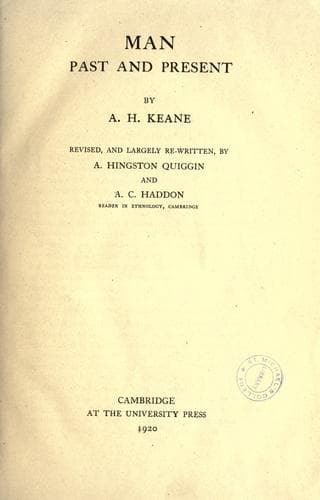
Man, Past and PresentKeane, A. H. (Augustus Henry)
History
Man, Past and Present
Keane, A. H. (Augustus Henry)
Anthropology; Ethnology
On the other hand they approach nearer to the Burmese in their mental
characters; in their frank, independent spirit, inquisitiveness, and
kindness towards their women, who enjoy complete social equality, as in
Burma; and lastly in their universal belief in spirits called _iwi_ or
_siya_, who, like the _nats_ of Indo-China, cause sickness and death
unless scared away or appeased by offerings. Like the Burmese, also,
they place a piece of money in the mouth or against the cheek of a
corpse before burial, to help in the other world.
One of the few industries is the manufacture of a peculiar kind of rough
painted pottery, which is absolutely confined to the islet of Chowra, 5
miles north of Teressa. The reason of this restriction is explained by a
popular legend, according to which in remote ages the Great Unknown
decreed that, on pain of sudden death, an earthquake, or some such
calamity, the making of earthenware was to be carried on only in Chowra,
and all the work of preparing the clay, moulding and firing the pots,
was to devolve on the women. Once, a long time ago, one of these women,
when on a visit in another island, began, heedless of the divine
injunction, to make a vessel, and fell dead on the spot. Thus was
confirmed the tradition, and no attempt has since been made to infringe
the "Chowra monopoly[568]."
All things considered, it may be inferred that the archipelago was
originally occupied by primitive peoples of Malayan stock now
represented by the Shom Pen of Great Nicobar, and was afterwards
re-settled on the coastlands by Indo-Chinese and Malayan intruders, who
intermingled, and either extirpated or absorbed, or else drove to the
interior the first occupants. Nicobar thus resembles Formosa in its
intermediate position between the continental and Oceanic Mongol
populations. Another point of analogy is the absence of Negritoes from
both of these insular areas, where anthropologists had confidently
anticipated the presence of a dark element like that of the Andamanese
and Philippine Aeta.
FOOTNOTES:
[492] Here E. T. Hamy finds connecting links between the true Malays and
the Indonesians in the Bicols of Albay and the Bisayas of Panay ("Les
Races Malaiques et Americaines," in _L'Anthropologie_, 1896, p. 136).
Used in this extended sense, Hamy's _Malaique_ corresponds generally to
our _Malayan_ as defined presently.
[493] Ethnically Malayo-Polynesian is an impossible expression, because
it links together the Malays, who belong to the Mongol, and the
Polynesians, who belong to the Caucasic division. But as both
undoubtedly speak languages of the same linguistic stock the expression
is permitted in philology, although, as P. W. Schmidt points out,
"Malay" and "Polynesian" are not of equal rank: and the combination is
as unbalanced as "Indo-Bavarian" for "Indo-Germanic"; it is best
therefore to adopt Schmidt's term _Austronesian_ for this family of
languages (_Die Mon-Khmer Voelker_, 1906, p. 69).
Public-domain text, read in full here on John Shaqi.
Reviews
Reviews
No reviews yet
Be the first to share your thoughts on this work.
Elsewhere in the archive
Join the Discussion
Join the discussion
Sign in to leave a comment or review.
Sign InorCreate an account