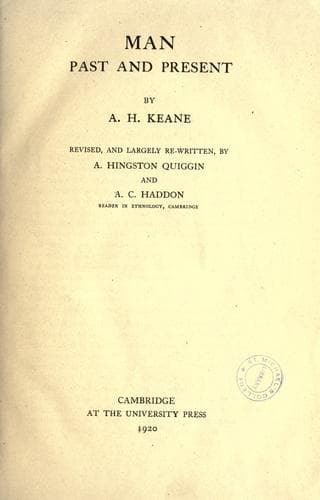
Man, Past and PresentKeane, A. H. (Augustus Henry)
History
Man, Past and Present
Keane, A. H. (Augustus Henry)
Anthropology; Ethnology
#Colour#, _light or dirty yellowish amongst all true Mongols and
Siberians_; _very variable (white, sallow, swarthy) in the transitional
groups (Finns, Lapps, Magyars, Bulgars, Western Turks), and many Manchus
and Koreans_; _in Japan the unexposed parts of the body also white_.
#Skull#, _highly brachycephalic in the true Mongol(80 to 85)_; _variable
(sub-brachy and sub-dolicho) in most transitional groups and even some
Siberians (Ostyaks and Voguls 77)_. #Jaws#, #cheek-bones#, #nose#, _and_
#eyes# _much the same as in South Mongols_; _but nose often large and
straight, and eyes straight, greyish, or even blue in Finns, Manchus,
Koreans, and some other Mongolo-Caucasians_.
#Stature#, _usually short (below 1.68 m., 5 ft. 6 in.), but many Manchus
and Koreans tall, 1.728 m. to 1.778 m. (5 ft. 8 or 10 in.)_. #Lips#,
#arms#, #legs#, _and_ #feet#, _usually the same as South Mongols_; _but
Japanese legs disproportionately short_.
#Temperament#, _of all true Mongols and many Mongoloids, dull, reserved,
somewhat sullen and apathetic_; _but in some groups (Finns, Japanese)
active and energetic_; _nearly all brave, warlike, even fierce, and
capable of great atrocities, though not normally cruel_; _within the
historic period the character has almost everywhere undergone a marked
change from a rude and ferocious to a milder and more humane
disposition_; _ethical tone higher than South Mongol, with more
developed sense of right and wrong_.
#Speech#, _very uniform_; _apparently only one stock language_
(#Finno-Tatar# _or_ #Ural-Altaic Family#), _a highly typical
agglutinating form with no prefixes, but numerous postfixes attached
loosely to an unchangeable root, by which their vowels are modified in
accordance with subtle laws of vocalic harmony_; _the chief members of
the family (Finnish, Magyar, Turkish, Mongol, and especially Korean and
Japanese) diverge greatly from the common prototype_.
#Religion#, _originally spirit-worship through a mediator_ (Shaman),
_perhaps everywhere, and still exclusively prevalent amongst Siberian
and all other uncivilised groups_; _all Mongols proper, Manchus, and
Koreans nominal Buddhists_; _all Turki peoples Moslem_; _Japanese
Buddhists and Shintoists_; _Finns, Lapps, Bulgars, Magyars, and some
Siberians real or nominal Christians_.
#Culture#, _rude and barbaric rather than savage amongst the Siberian
aborigines, who are nearly all nomadic hunters and fishers with
half-wild reindeer herds but scarcely any industries_; _the Mongols
proper, Kirghiz, Uzbegs and Turkomans semi-nomadic pastors_; _the
Anatolian and Balkan Turks, Manchus, and Koreans settled agriculturists,
with scarcely any arts or letters and no science_; _Japanese, Finns,
Bulgars and Magyars civilised up to, and in some respects beyond the
European average (Magyar and Finnish literature, Japanese art)_.
#Mongol Proper.# _Sharra (Eastern), Kalmak (Western), Buryat (Siberian)
Mongol._
#Tungus.# _Tungus proper, Manchu, Gold, Oroch, Lamut._
Public-domain text, read in full here on John Shaqi.
Reviews
Reviews
No reviews yet
Be the first to share your thoughts on this work.
Elsewhere in the archive
Join the Discussion
Join the discussion
Sign in to leave a comment or review.
Sign InorCreate an account