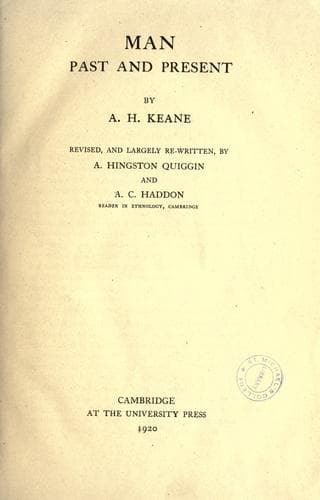
Man, Past and PresentKeane, A. H. (Augustus Henry)
History
Man, Past and Present
Keane, A. H. (Augustus Henry)
Anthropology; Ethnology
With the progress of archaeological research, it becomes daily more
evident that the whole of the North Mongol domain, from Finland to
Japan, has passed through the Stone and Metal Ages, like most other
habitable parts of the globe. During his wanderings in Siberia and
Mongolia in the early nineties, Hans Leder[578] came upon countless
prehistoric stations, kurgans (barrows), stone circles, and many
megalithic monuments of various types. In West Siberia the barrows,
which consist solely of earth without any stone-work, are by the present
inhabitants called _Chudskiye Kurgani_, "Chudish Graves," and, as in
North Russia, this term "Chude" is ascribed to a now vanished unknown
race which formerly inhabited the land. To them, as to the "Toltecs" in
Central America, all ancient monuments are credited, and while some
regard them as prehistoric Finns, others identify them with the historic
Scythians, the Scythians of Herodotus.
There are reasons, however, for thinking that the Chudes may represent
an earlier race, the men of the Stone Age, who, migrating from north
Europe eastwards, had reached the Tom valley (which drains to the Obi)
before the extinction of the mammoth, and later spread over the whole of
northern Asia, leaving everywhere evidence of their presence in the
megalithic monuments now being daily brought to light in East Siberia,
Mongolia, Korea, and Japan. This view receives support from the
characters of two skulls found in 1895 by A. P. Mostitz in one of the
five prehistoric stations on the left bank of the Sava affluent of the
Selenga river, near Ust-Kiakta in Trans-Baikalia. They differ markedly
from the normal Buryat (Siberian Mongol) type, recalling rather the
long-shaped skulls of the South Russian kurgans, with cephalic indices
73.2 and 73.5, as measured by M. J. D. Talko-Hryncewicz[579]. Thus, in
the very heart of the Mongol domain, the characteristically round-headed
race would appear to have been preceded, as in Europe, by a long-headed
type.
In East Siberia, and especially in the Lake Baikal region, Leder found
extensive tracts strewn with kurgans, many of which have already been
explored, and their contents deposited in the Irkutsk museum. Amongst
these are great numbers of stone implements, and objects made of bone
and mammoth tusks, besides carefully worked copper ware, betraying
technical skill and some artistic taste in the designs. In
Trans-Baikalia, still farther east, with the kurgans are associated the
so-called _Kameni Babi_, "Stone Women," monoliths rough-hewn in the form
of human figures. Many of these monoliths bear inscriptions, which,
however, appear to be of recent date (mostly Buddhist prayers and
formularies), and are not to be confounded with the much older rock
inscriptions deciphered by W. Thomsen through the Turki language.
Public-domain text, read in full here on John Shaqi.
Reviews
Reviews
No reviews yet
Be the first to share your thoughts on this work.
Elsewhere in the archive
Join the Discussion
Join the discussion
Sign in to leave a comment or review.
Sign InorCreate an account