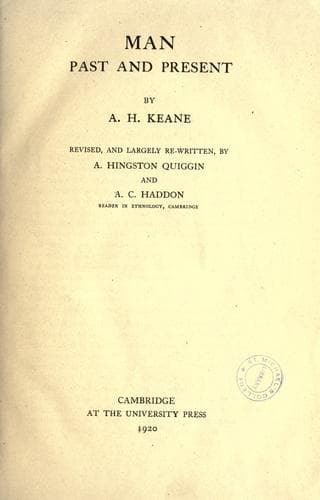
Man, Past and PresentKeane, A. H. (Augustus Henry)
History
Man, Past and Present
Keane, A. H. (Augustus Henry)
Anthropology; Ethnology
Continuing his investigations in Mongolia proper, Leder here also
discovered earthen kurgans, which, however, differed from those of
Siberia by being for the most part surmounted either with circular or
rectangular stone structures, or else with monoliths. They are called
_Kueruektsur_ by the present inhabitants, who hold them in great awe, and
never venture to touch them. Unfortunately strangers also are unable to
examine their contents, all disturbance of the ground with spade or
shovel being forbidden under pain of death by the Chinese officials, for
fear of awakening the evil spirits, now slumbering peacefully below the
surface. The Siberian burial mounds have yielded no bronze, a fact which
indicates considerable antiquity, although no date can be set for its
introduction into these regions. Better evidence of antiquity is found
in the climatic changes resulting in recent desiccation, which must
have taken place here as elsewhere, for the burials bear witness to the
existence of a denser population than could be supported at the present
time[580].
Such an antiquity is indeed required to explain the spread of neolithic
remains to the Pacific seaboard, and especially to Korea and Japan. In
Korea W. Gowland examined a dolmen 30 miles from Seul, which he
describes and figures[581], and which is remarkable especially for the
disproportionate size of the capstone, a huge undressed megalith 14-1/2
by over 13 feet. He refers to four or five others, all in the northern
part of the peninsula, and regards them as "intermediate in form between
a cist and a dolmen." But he thinks it probable that they were never
covered by mounds, but always stood as monuments above ground, in this
respect differing from the Japanese, the majority of which are all
buried in tumuli. In some of their features these present a curious
resemblance to the Brittany structures, but no stone implements appear
to have been found in any of the burial mounds, and the Japanese
chambered tombs, according to Hamada, Professor of Archaeology in Kyoto
University, are usually attributed to the Iron Age (fifth to seventh
centuries A.D.[582]).
In many districts Japan contains memorials of a remote past--shell
mounds, cave-dwellings, and in Yezo certain pits, which are not occupied
by the present Ainu population, but are by them attributed to the
_Koro-pok-guru_, "People of the Hollows," who occupied the land before
their arrival, and lived in huts built over these pits. Similar remains
on an islet near Nemuro on the north-east coast of Yezo are said by the
Japanese to have belonged to the _Kobito_, a dwarfish race exterminated
by the Ainu, hence apparently identical with the Koro-pok-guru. They are
associated by John Milne with some primitive peoples of the Kurile
Islands, Sakhalin, and Kamchatka, who, like the Eskimo of the American
coast, had extended formerly much farther south than at present.
Public-domain text, read in full here on John Shaqi.
Reviews
Reviews
No reviews yet
Be the first to share your thoughts on this work.
Elsewhere in the archive
Join the Discussion
Join the discussion
Sign in to leave a comment or review.
Sign InorCreate an account