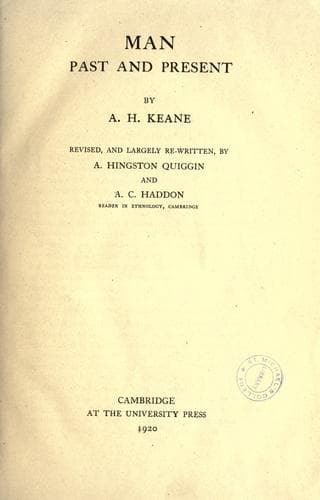
Man, Past and PresentKeane, A. H. (Augustus Henry)
History
Man, Past and Present
Keane, A. H. (Augustus Henry)
Anthropology; Ethnology
Even after the capture of Susa by Ashurbanipal, Elam again rose to great
power under Cyrus the Great, who, however, was no Persian adventurer, as
stated by Herodotus, but the legitimate Elamite ruler, as inscribed on
his cylinder and tablet now in the British Museum:--"Cyrus, the great
king, the king of Babylon, the king of Sumir and Akkad, the king of the
four zones, the son of Kambyses, the great king, the king of Elam, the
grandson of Cyrus the great king," who by the favour of Merodach has
overcome the black-headed people (_i.e._ the Akkads) and at last entered
Babylon in peace. On an earlier cylinder Nabonidus, last king of
Babylon, tells us how this same Cyrus subdued the Medes--here called
_Mandas_, "Barbarians"--and captured their king Astyages and his capital
Ekbatana. But although Cyrus, hitherto supposed to be a Persian and a
Zoroastrian monotheist, here appears as an Elamite and a polytheist, "it
is pretty certain that although descended from Elamite kings, these were
[at that time] kings of Persian race, who, after the destruction of the
old [Elamite] monarchy by Ashurbanipal, had established a new dynasty at
the city of Susa. Cyrus always traces his descent from Achaemenes, the
chief of the leading Persian clan of Pasargadae[604]." Hence although
wrong in speaking of Cyrus as an adventurer, Herodotus rightly calls him
a Persian, and at this late date Elam itself may well have been already
Aryanised in speech[605], while still retaining its old Sumerian
religion. The Babylonian pantheon survived, in fact, till the time of
Darius Hystaspes, who introduced Zoroastrianism with its supreme gods,
Ahura-Mazda, creator of all good, and Ahriman, author of all evil.
It is now possible to gain some idea of the gradual growth of the city
states of Babylonia. Beginning with a mere collection of rude reed huts,
these were succeeded by structures of sun-dried bricks, built in a group
for mutual protection, probably around a centre of a local god, and
surrounded by a wall. The land around the settlement was irrigated by
canals, and here the corn and vegetables were grown and the flocks and
herds were tended for the maintenance of the population. The central
figure was always the god, who occasionally gave his name to the site,
and who was the owner of all the land, the inhabitants being merely his
tenants who owed him rent for their estates. It was the god who waged
wars with the neighbours, and with whom treaties were made. The treaty
between Lagash and Umma fixing the limitations of their boundaries, a
constant matter of dispute, was made by Ningirsu, god of Lagash, and the
city god of Umma, under the arbitration of Enlil, the chief of the gods,
whose central shrine was at Nippur.
Public-domain text, read in full here on John Shaqi.
Reviews
Reviews
No reviews yet
Be the first to share your thoughts on this work.
Elsewhere in the archive
Join the Discussion
Join the discussion
Sign in to leave a comment or review.
Sign InorCreate an account