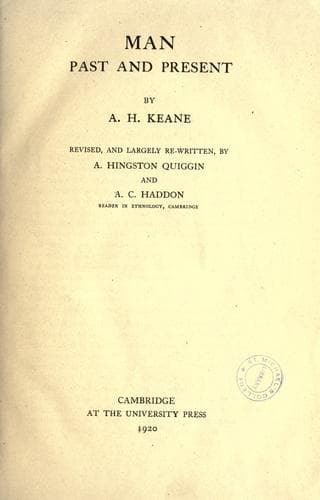
Man, Past and PresentKeane, A. H. (Augustus Henry)
History
Man, Past and Present
Keane, A. H. (Augustus Henry)
Anthropology; Ethnology
With the growth of the cities disputes of territory were sure to arise,
and either by conquest or amalgamation, cities became absorbed into
states. The problem then was the adjustment of the various city gods,
each reigning supreme in his own city, but taking a higher or lower
place in the Babylonian pantheon. When one city gained a supremacy over
all its neighbours, its governor might assume the title of king. But the
king was merely the _patesi_, the steward of the city god. Even when the
supremacy was sufficiently permanent for the establishment of a dynasty,
this was a dynasty of the city rather than of a family, for the
successive kings were not necessarily of the same family[606].
Among the city gods who developed into powerful deities were Anu of Uruk
(Erech), Enlil of Nippur and Ea of Eridu (originally a sea-port). These
became the supreme triad, Anu ruling over the heavens, enthroned on the
northern pole, as king and father of the gods; Enlil, the Semitic Bel,
god of earth, lord of the lands, formerly chief of all the gods; and Ea,
god of the water-depths, whose son was ultimately to eclipse his father
as Marduk of Babylon. A second triad is composed of the local deities
who developed into Sin, the moon-god of Ur, Shamash the sun-god of
Larsa, and the famous Ishtar, the great mother, goddess of love and
queen of heaven. The realm of the dead was a dark place under the earth,
where the dead lived as shadows, eating the dust of the earth. Their lot
depended partly on their earlier lives, and partly on the devotion of
their surviving relatives. Although their dead kings were deified there
seems to be no evidence for a belief in a general resurrection or in the
transmigration of souls. The hymns and prayers to the gods however show
a very high religious level in spite of the important part played by
soothsaying and exorcism, relics of earlier culture. The permanence of
these may be partly ascribed to the essentially theocratic character of
Babylonian government. The king was merely the agent of the god, whose
desires were interpreted by the priestly soothsayers and exorcists, and
no action could be undertaken in worldly or in religious concerns
without their superintendence. The kings occasionally attempted to free
themselves from the power of the priests, but the attempt was always
vain. The power of the priests had often a sound economic basis, for the
temples of the great cities were centres of vast wealth and of
far-reaching trade, as is proved by the discovery of the commercial
contracts stored in the temple archives[607].
Public-domain text, read in full here on John Shaqi.
Reviews
Reviews
No reviews yet
Be the first to share your thoughts on this work.
Elsewhere in the archive
Join the Discussion
Join the discussion
Sign in to leave a comment or review.
Sign InorCreate an account