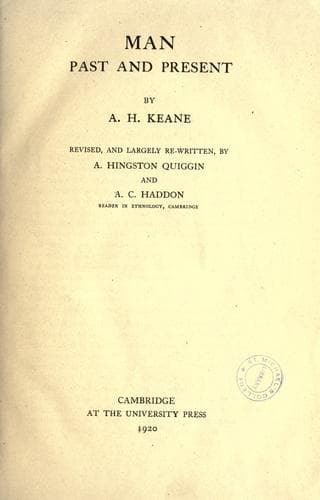
Man, Past and PresentKeane, A. H. (Augustus Henry)
History
Man, Past and Present
Keane, A. H. (Augustus Henry)
Anthropology; Ethnology
One element the two peoples certainly had in common--a highly developed
agricultural system, which formed the foundation of their greatness, and
was maintained in a rainless climate by a stupendous system of
irrigation works. Such works were carried out on a prodigious scale by
the ancient Babylonians six or eight thousand years ago. The plains of
the Lower Euphrates and Tigris, since rendered desolate under Turkish
misrule, are intersected by the remains of an intricate network of
canalisation covering all the space between the two rivers, and are
strewn with the ruins of many great cities, whose inhabitants, numbering
scores of thousands, were supported by the produce of a highly
cultivated region, which is now an arid waste varied only by crumbling
mounds, stagnant waters, and the camping-grounds of a few Arab
tent-dwellers.
* * * * *
Those who attach weight to distinctive racial qualities have always
found a difficulty in attributing this wonderful civilisation to the
same Mongolic people, who in their own homes have scarcely anywhere
advanced beyond the hunting, fishing, or pastoral states. But it has
always to be remembered that man, like all other zoological forms,
necessarily reflects the character of his environment. The Mongols might
in time become agriculturalists in the alluvial Mesopotamian lands,
though the kindred people who give their name to the whole ethnical
division and present its physical characters in an exaggerated form,
ever remain tented nomads on the dry Central Asiatic steppe, which
yields little but herbage, and is suitable for tillage only in a few
more favoured districts. Here the typical Mongols, cut off from the
arable lands of South Siberia by the Tian-shan and Altai ranges, and to
some extent denied access to the rich fluvial valleys of the Middle
Kingdom by the barrier of the Great Wall, have for ages led a pastoral
life in the inhabitable tracts and oases of the Gobi wilderness and the
Ordos region within the great bend of the Hoang-ho. During the historic
period these natural and artificial ramparts have been several times
surmounted by fierce Mongol hordes, pouring like irresistible
flood-waters over the whole of China and many parts of Siberia, and
extending their predatory or conquering expeditions across the more open
northern plains westwards nearly to the shores of the Atlantic. But such
devastating torrents, which at intervals convulsed and caused
dislocations amongst half the settled populations of the globe, had
little effect on the tribal groups that remained behind. These continued
and continue to occupy the original camping-grounds, as changeless and
uniform in their physical appearance, mental characters, and social
usages as the Arab bedouins and all other inhabitants of monotonous
undiversified steppe lands.
Public-domain text, read in full here on John Shaqi.
Reviews
Reviews
No reviews yet
Be the first to share your thoughts on this work.
Elsewhere in the archive
Join the Discussion
Join the discussion
Sign in to leave a comment or review.
Sign InorCreate an account