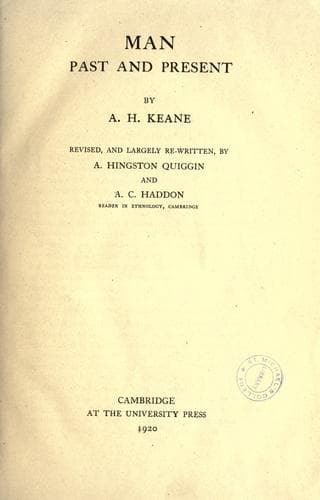
Man, Past and PresentKeane, A. H. (Augustus Henry)
History
Man, Past and Present
Keane, A. H. (Augustus Henry)
Anthropology; Ethnology
De Ujfalvy's suggestion that the typical Mongols of the plains, with
whom we are now dealing, were originally a long-headed race, can
scarcely be taken seriously. At present and, in fact, throughout
historic times, all true Mongol peoples are and have been distinguished
by a high degree of brachycephaly, with cephalic index generally from 87
upwards, and it may be remembered that the highest known index of any
undeformed skull was that of Huxley's Mongol (98.21). But, as already
noticed, those recovered from prehistoric, or neolithic kurgans, are
found to be dolichocephalous like those of palaeolithic and early
neolithic man in Europe.
Taken in connection with the numerous prehistoric remains above recorded
from all parts of Central Asia and Siberia, this fact may perhaps help
to bring de Ujfalvy's view into harmony with the actual conditions.
Everything will be explained by assuming that the proto-Mongolic tribes,
spreading from the Tibetan plateau over the plains now bearing their
name, found that region already occupied by the long-headed Caucasic
peoples of the Stone Ages, whom they either exterminated or drove north
to the Altai uplands, and east to Manchuria and Korea, where a strong
Caucasic strain still persists. De Ujfalvy's long-heads would thus be,
not the proto-Mongols who were always round-headed, but the long-headed
neolithic pre-Mongol race expelled by them from Mongolia who may
provisionally be termed proto-Nordics.
That this region has been their true home since the first migrations
from the south there can be no doubt. Here land and people stand in the
closest relation one to the other; here every conspicuous physical
feature recalls some popular memory; every rugged crest is associated
with the name of some national hero, every lake or stream is still
worshipped or held in awe as a local deity, or else the abode of the
ancestral shades. Here also the Mongols proper form two main divisions,
_Sharra_ in the east and _Kalmuk_ in the west, while a third group, the
somewhat mixed _Buryats_, have long been settled in the Siberian
provinces of Irkutsk and Trans-Baikalia. Under the Chinese semi-military
administration all except the Buryats, who are Russian subjects, are
constituted since the seventeenth century in 41 _Aimaks_ (large tribal
groups or principalities with hereditary khans) and 226 _Koshungs_,
"Banners," that is, smaller groups whose chiefs are dependent on the
khans of their respective Aimaks, who are themselves directly
responsible to the imperial government. Subjoined is a table of these
administrative divisions, which present a curious but effective
combination of the tribal and political systems, analogous to the
arrangement in Pondoland and some other districts in Cape Colony, where
the hereditary tribal chief assumes the functions of a responsible
British magistrate.
Tribal or Territorial Aimaks Koshungs
Divisions (Principalities) (Banners)
Public-domain text, read in full here on John Shaqi.
Reviews
Reviews
No reviews yet
Be the first to share your thoughts on this work.
Elsewhere in the archive
Join the Discussion
Join the discussion
Sign in to leave a comment or review.
Sign InorCreate an account