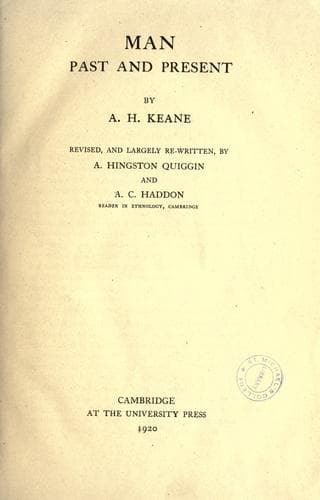
Man, Past and PresentKeane, A. H. (Augustus Henry)
History
Man, Past and Present
Keane, A. H. (Augustus Henry)
Anthropology; Ethnology
Caucasic features--light eyes, large nose, hair often brown, full beard,
fair and even white skin, tall stature--are conspicuous, especially
amongst the upper classes and many of the southern Koreans[651]. They
are thus shown to be a mixed race, the Mongol element dominating in the
north, as might be expected, and the Caucasic in the south.
These conclusions seem to be confirmed by what is known of the early
movements, migrations, and displacements of the populations in
north-east Asia about the dawn of history. In these vicissitudes the
Koreans, as they are now called[652], appear to have first taken part in
the twelfth century B.C., when the peninsula was already occupied, as it
still is, by Mongols, the _Sien-pi_, in the north, and in the south by
several branches of the _Hans_ (_San-San_), of whom it is recorded that
they spoke a language unintelligible to the Sien-pi, and resembled the
Japanese in appearance, manners, and customs. From this it may be
inferred that the Hans were the true aborigines, probably direct
descendants of the Caucasic peoples of the New Stone Age, while the
Sien-pi were Mongolic (Tungusic) intruders from the present Manchuria.
For some time these Sien-pi played a leading part in the political
convulsions prior and subsequent to the erection of the Great Wall by
Shih Hwang Ti, founder of the Tsin dynasty (221-209 B.C.)[653]. Soon
after the completion of this barrier, the _Hiung-nu_, no longer able to
scour the fertile plains of the Middle Kingdom, turned their arms
against the neighbouring _Yue-chi_, whom they drove westwards to the
Sungarian valleys. Here they were soon displaced by the _Usuns_
(_Wusun_), a fair, blue-eyed people of unknown origin, who have been
called "Aryans," and even "Teutons," and whom Ch. de Ujfalvy identifies
with the tall long-headed western blonds (de Lapouge's _Homo
Europaeus_), mixed with brown round-headed hordes of white
complexion[654]. Accepting this view, we may go further, and identify
the Usuns, as well as the other white peoples of the early Chinese
records, with the already described Central Asiatic Caucasians of the
Stone Ages, whose osseous remains we now possess, and who come to the
surface in the very first Chinese documents dealing with the turbulent
populations beyond the Great Wall. The white element, with all the
correlated characters, existed beyond all question, for it is
continuously referred to in those documents. How is its presence in East
Central Asia, including Manchuria and Korea, to be explained? Only on
two assumptions--_proto-historic_ migrations from the Far West, barred
by the proto-historic migrations from the Far East, as largely
determined by the erection of the Great Wall; or _pre-historic_
(neolithic) migrations, also from the Far West, but barred by no serious
obstacle, because antecedent to the arrival of the proto-Mongolic tribes
from the Tibetan plateau. The true solution of the endless ethnical
Public-domain text, read in full here on John Shaqi.
Reviews
Reviews
No reviews yet
Be the first to share your thoughts on this work.
Elsewhere in the archive
Join the Discussion
Join the discussion
Sign in to leave a comment or review.
Sign InorCreate an account