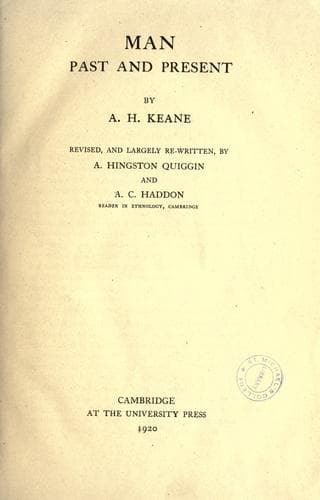
Man, Past and PresentKeane, A. H. (Augustus Henry)
History
Man, Past and Present
Keane, A. H. (Augustus Henry)
Anthropology; Ethnology
complications in the extreme East, as in the Oceanic world, will still
be found in the now-demonstrated presence of a Caucasic element
antecedent to the Mongol in those regions.
When the Hiung-nu[655] power was weakened by their westerly migrations
to Sungaria and south-west Siberia (Upper Irtysh and Lake Balkash
depression), and broken into two sections during their wars with the two
Han dynasties (201 B.C.-220 A.D.), the Korean Sien-pi became the
dominant nation north of the Great Wall. After destroying the last
vestiges of the unstable Hiung-nu empire, and driving the Mongolo-Turki
hordes still westwards, the Yuan-yuans, most powerful of all the Sien-pi
tribes, remained masters of East Central Asia for about 400 years and
then disappeared from history[656]. At least after the sixth century
A.D. no further mention is made of the Sien-pi principalities either in
Manchuria or in Korea. Here, however, they appear still to form a
dominant element in the northern (Mongol) provinces, calling themselves
Ghirin (Khirin), from the Khirin (Sungari) valley of the Amur, where
they once held sway.
Since those days Korea has been alternately a vassal State and a
province of the Middle Kingdom, with interludes of Japanese ascendancy,
interrupted only by the four centuries of Korai ascendancy (934-1368).
This was the most brilliant epoch in the national records, when Korea
was rather the ally than the vassal of China, and when trade, industry,
and the arts, especially porcelain and bronze work, flourished in the
land. But by centuries of subsequent misrule, a people endowed with
excellent natural qualities have been reduced to the lowest state of
degradation. Before the reforms introduced by the political events of
1895-96, "the country was eaten up by officialism. It is not only that
abuses without number prevailed, but the whole system of government was
an abuse, a sea of corruption, without a bottom or a shore, an engine of
robbery, crushing the life out of all industry[657]." But an improvement
was speedily remarked. "The air of the men has undergone a subtle and
real change, and the women, though they nominally keep up their habits
by seclusion, have lost the hang-dog air which distinguished them at
home. The alacrity of movement is a change also, and has replaced the
conceited swing of the _yang-ban_ [nobles] and the heartless lounge of
the peasant." This improvement was merely temporary. The last years of
the century were marked by the waning of Japanese influence, due to
Russian intrigues, the restoration of absolute monarchy together with
its worst abuses, the abandonment of reforms and a retrograde movement
throughout the kingdom. The successes of Japan in 1904-5 resulted in the
restoration of her ascendancy, culminating in 1910 in the cession of
sovereignty by the emperor of Korea to the emperor of Japan.
Public-domain text, read in full here on John Shaqi.
Reviews
Reviews
No reviews yet
Be the first to share your thoughts on this work.
Elsewhere in the archive
Join the Discussion
Join the discussion
Sign in to leave a comment or review.
Sign InorCreate an account