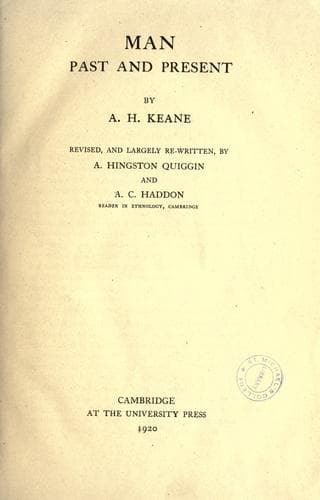
Man, Past and PresentKeane, A. H. (Augustus Henry)
History
Man, Past and Present
Keane, A. H. (Augustus Henry)
Anthropology; Ethnology
Thus this highly gifted people are being assimilated to the western
world in their social and religious, as well as their political
institutions. Their intellectual powers, already tested in the fields of
war, science, diplomacy, and self-government, are certainly superior to
those of all other Asiatic peoples, and this is perhaps the best
guarantee for the stability of the stupendous transformation that a
single generation has witnessed from an exaggerated form of medieval
feudalism to a political and social system in harmony with the most
advanced phases of modern thought. The system has doubtless not yet
penetrated to the lower strata, especially amongst the rural
populations. But their natural receptivity, combined with a singular
freedom from "insular prejudice," must ensure the ultimate acceptance of
the new order by all classes of the community.
FOOTNOTES:
[569] As fully explained in _Eth._ p. 303.
[570] Mark Aurel Stein, _Sand-buried Cities of Khotan_, 1903, and _Geog.
Journ._, July, Sept. 1909.
[571] R. Pumpelly, _Explorations in Turkestan_, 1905, and _Explorations
in Turkestan; Expedition of 1904_, 1908.
[572] Sven Hedin, _Scientific Results of a Journey in Central Asia_,
1899-1902, 1906, and _Geog. Journ._, April, 1909.
[573] Douglas Carruthers, _Unknown Mongolia_, 1913 (with bibliography).
[574] Ellsworth Huntington, _The Pulse of Asia_, 1910.
[575] "The Asiatic Background," _Cambridge Medieval History_, Vol. I.
1911.
[576] _Memoires de la Delegation en Perse; Recherches archeologiques_
(from 1899).
[577] _Sand-buried Cities of Khotan_, 1903.
[578] "Ueber Alte Grabstaetten in Sibirien und der Mongolei," in _Mitt.
d. Anthrop. Ges._, Vienna, 1895, XXV. 9.
[579] Th. Volkov, in _L'Anthropologie_, 1896, p. 82.
[580] Too much stress must not, however, be laid upon the theory of
gradual desiccation as a factor in depopulation. There are many causes
such as earthquake, water-spouts, shifting of currents, neglect of
irrigation and, above all, the work of enemies to account for the
sand-buried ruins of populous cities in Central Asia. See T. Peisker,
"The Asiatic Background," _Cambridge Medieval History_, Vol. I. 1911, p.
326.
[581] _Journ. Anthr. Inst._ 1895, p. 318 sq.
[582] Cf. _Archaeologia Cambrensis_, 6th Ser. XIV. Part 1, 1914, p. 131,
and _Zeitschr. f. Ethnol._ 1910, p. 601.
[583] "Zur Praehistorik Japans," _Globus_, 1896, No. 10.
[584] The best account of the archaeology of Japan will be found in
_Prehistoric Japan_, by N. G. Munro, 1912.
[585] _Die Bronzezeit Finnlands_, Helsingfors, 1897.
[586] "Akkadian," first applied by Rawlinson to the non-Semitic texts
found at Nineveh, is still often used by English writers in place of the
more correct _Sumerian_, the Akkadians being now shown to be Semitic
immigrants into Northern Babylonia (p. 264).
[587] Cf. L. W. King, _History of Sumer and Akkad_, 1910, pp. 5, 6.
[588] _Ueber die Summerische Sprache_, Paper read at the Russian
Archaeological Congress, Riga, 1896.
Public-domain text, read in full here on John Shaqi.
Reviews
Reviews
No reviews yet
Be the first to share your thoughts on this work.
Elsewhere in the archive
Join the Discussion
Join the discussion
Sign in to leave a comment or review.
Sign InorCreate an account