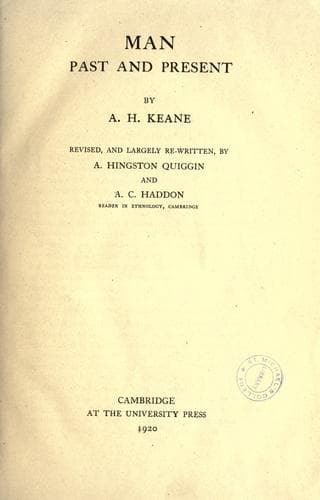
Man, Past and PresentKeane, A. H. (Augustus Henry)
History
Man, Past and Present
Keane, A. H. (Augustus Henry)
Anthropology; Ethnology
[617] Either from the Chinese _Tunghu_, "Eastern Barbarians," or from
the Turki _Tinghiz_, as in Isaac Massa: _per interpretes se Tingoesi
vocari dixerunt_ (_Descriptio_, etc., Amsterdam, 1612). But there is no
collective national name, and at present they call themselves _Don-ki_,
_Boia_, _Boie_, etc., terms all meaning "Men," "People." In the Chinese
records they are referred to under the name of _I-lu_ so early as 263
A.D., when they dwelt in the forest region between the Upper Temen and
Yalu rivers on the one hand and the Pacific Ocean on the other, and paid
tribute in kind--sable furs, bows, and stone arrow-heads. Arrows and
stone arrow-heads were also the tribute paid to the emperors of the
Shang dynasty (1766-1154 B.C.) by the _Su-shen_, who dwelt north of the
Liao-tung peninsula, so that we have here official proof of a Stone Age
of long duration in Manchuria. Later, the Chinese chronicles mention the
_U-ki_ or _Mo-ho_, a warlike people of the Sungari valley and
surrounding uplands, who in the 7th century founded the kingdom of
_Pu-ha[=i]_, overthrown in 925 by the Khitans of the Lower Sungari below
its Noni confluence, who were themselves Tunguses and according to some
Chinese authorities the direct ancestors of the Manchus.
[618] "C'est la tendance de la tete a se developper en hauteur, juste en
sens inverse de l'aplatissement vertical du Mongol. La tete du Turc est
donc a la fois plus haute et plus courte" (_L'Anthropologie_, VI. 3, p.
8).
[619] Reclus, VI.; Eng. ed. p. 360.
[620] V. M. Mikhailovskii, _Shamanism in Siberia and European Russia_,
translated by Oliver Wardrop, _Journ. Anthr. Inst._ 1895, p. 91.
[621] M. A. Czaplicka, _Aboriginal Siberia_, 1914. Part III. discusses
Shamanism, pp. 166-255.
[622] Hakluyt, 1809 ed., I. p. 317 sq.
[623] Quoted by Mikhailovskii, p. 144.
[624] Cf. H. A. Giles, _China and the Manchus_, 1912.
[625] _Souvenirs d'un voyage dans la Tartarie_, 1853, I. 162.
[626] _Through Siberia_, 1882, Vol. II. p. 172.
[627] European visitors often notice with surprise the fine physique of
these natives, many of whom average nearly six feet in height. But there
is an extraordinary disparity between the two sexes, perhaps greater
than in any other country. The much smaller stature and feebler
constitution of the women is no doubt due to the detestable custom of
crippling the feet in childhood, thereby depriving them of natural
exercise during the period of growth. It may be noted that the
anti-foot-bandaging movement is making progress throughout China, the
object being to abolish the cruel practice by making the _kin lien_
("golden lilies") unfashionable, and the _ti mien_, the "heavenly
feet,"--_i.e._ the natural--popular in their stead.
[628] H. Lansdell, _Through Siberia_, 1882, II. p. 172.
[629] _De l'Harmonie des Voyelles dans les Langues Uralo-Altaiques_,
1874, p. 67 sq.
Public-domain text, read in full here on John Shaqi.
Reviews
Reviews
No reviews yet
Be the first to share your thoughts on this work.
Elsewhere in the archive
Join the Discussion
Join the discussion
Sign in to leave a comment or review.
Sign InorCreate an account