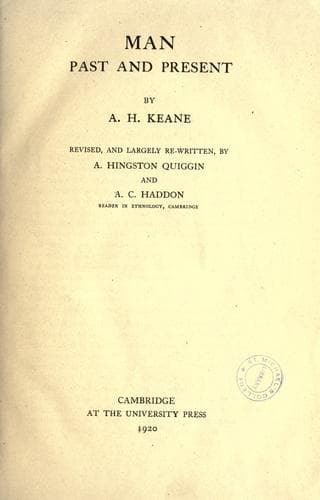
Man, Past and PresentKeane, A. H. (Augustus Henry)
History
Man, Past and Present
Keane, A. H. (Augustus Henry)
Anthropology; Ethnology
[630] _General Principles of the Structure of Language_, 1885, Vol. I.
p. 357. The evidence here chiefly relied upon is that afforded by the
Yakutic, a pure Turki idiom, which is spoken in the region of extremest
heat and cold (Middle and Lower Lena basin), and in which the principle
of progressive assonance attains its greatest development.
[631] Explained and illustrated by General Krahmer in _Globus_, 1896, p.
208 sq.
[632] H. Lansdell, _Through Siberia_, 1882, I. p. 299.
[633] "Ueber die Sprache der Jukagiren," in _Melanges Asiatiques_, 1859,
III. p. 595 sq.
[634] W. I. Jochelson recently discovered two independent Yukaghir
dialects. "Essay on the Grammar of the Yukaghir Language," _Annals N. Y.
Ac. Sc._ 1905; _The Yukaghir and the Yukaghirized Tungus._ _Memoir of
the Jesup North Pacific Expedition_, Vol. IX. 1910. For the Koryak see
his monograph in the same series, Vol. VI. 1905-8.
[635] _Ten Months among the Tents of the Tuski._
[636] "Ueber die Koriaken u. ihnen nahe verwandten Tchouktchen," _in
Bul. Acad. Sc._, St Petersburg, XII. p. 99.
[637] Peschel, _Races of Man_, p. 391, who says the Chukchi are "as
closely related to the Itelmes in speech as are Spaniards to
Portuguese."
[638] _Petermann's Mitt._ Vol. 25, 1879, p. 138.
[639] "The Girl and the Dogs, an Eskimo Folk-tale," _Amer.
Anthropologist_, June 1898, p. 181 sq.
[640] _Through the Gold Fields of Alaska to Bering Strait_, 1898.
[641] Cf. W. Bogoras, _The Chukchee, Memoir of the Jesup North Pacific
Expedition_, Vol. VII. 1904-10
[642] This, however, applies only to the fishing Koryaks, for G. Kennan
speaks highly of the domestic virtues, hospitality, and other good
qualities of the nomad groups (_Tent Life in Siberia_, 1871).
[643] See L. Sternberg, _The Tribes of the Amur River, Memoirs of the
Jesup North Pacific Expedition_, Vol. IV. 1900.
[644] _Mem. Imp. Soc. Nat. Sc._ XX. Supplement, Moscow, 1877.
[645] "Scheinen grosse Aenlichkeit in Sprache, Gesichtsbildung und
Sitten mit den Aino zu haben" (_Ueber die Aino_, Berlin, 1881, p. 12).
[646] _Through Siberia_, 1882, II. p. 227.
[647] _Ibid._ p. 235.
[648] _Ibid._ p. 221.
[649] _L'Anthropologie_, VI. No. 3.
[650] _Bul. du Museum d'Hist. Nat._ 1896, No. 4. All the skulls were
brachy or sub-brachy, varying from 81 to 83.8 and 84.8. The author
remarks generally that "photographes et cranes different, du tout au
tout, des choses similaires venues jusqu'a present de Mongolie et de
Chine, et font plutot penser au Japon, a Formose, et d'une maniere plus
generale a ce vaste ensemble de peuples maritimes que Lesson designait
jadis sous le nom de 'Mongols-pelasgiens,'" p. 3.
Public-domain text, read in full here on John Shaqi.
Reviews
Reviews
No reviews yet
Be the first to share your thoughts on this work.
Elsewhere in the archive
Join the Discussion
Join the discussion
Sign in to leave a comment or review.
Sign InorCreate an account