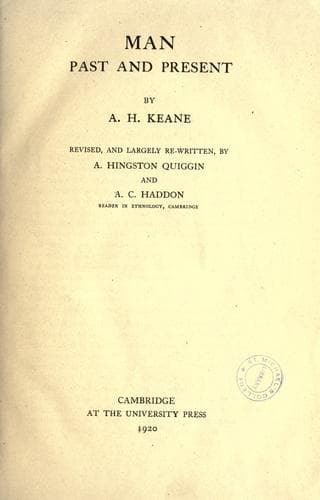
Man, Past and PresentKeane, A. H. (Augustus Henry)
History
Man, Past and Present
Keane, A. H. (Augustus Henry)
Anthropology; Ethnology
It may, indeed, be allowed that at present the great majority of the
Finno-Turki populations occupy a position amongst the varieties of
mankind which is extremely perplexing for the strict systematist. When
the whole division is brought under survey, every shade of transition is
observed between the Siberian Samoyeds of the Finnic branch and the
steppe Kirghiz of the Turki branch on the one hand, both of whom show
Mongol characters in an exaggerated form, and on the other the Osmanli
Turks and Hungarian Magyars, most of whom may be regarded as typical
Caucasians. Moreover, the difficulty is increased by the fact, already
pointed out, that these mixed Mongolo-Caucasic characters occur not only
amongst the late historic groups, but also amongst the earliest known
groups--"Chudes," Usuns, Uigurs and others--who may be called
Proto-Finnish and Proto-Turki peoples. But precisely herein lies the
solution of the problem. Most of the region now held by Turki and
Finnish nations was originally occupied by long-headed Caucasic men of
the late Stone Ages (see above). Then followed the Proto-Mongol
intruders from the Tibetan table-land, who partly submerged, partly
intermingled with their neolithic neighbours, many thus acquiring those
mixed characters by which they have been distinguished from the earliest
historic times. Later, further interminglings took place according as
the Finno-Turki hordes, leaving their original seats in the Altai and
surrounding regions, advanced westwards and came more and more into
contact with the European populations of Caucasic type.
We may therefore conclude that the majority of the Finno-Turki were
almost from the first a somewhat mixed race, and that during historic
times the original Mongol element has gradually yielded to the Caucasic
in the direction from east to west. Such is the picture now presented by
these heterogeneous populations, who in their primeval eastern seats are
still mostly typical Mongols, but have been more and more assimilated to
the European type in their new Anatolian, Baltic, Danubian, and Balkan
homes.
Public-domain text, read in full here on John Shaqi.
Reviews
Reviews
No reviews yet
Be the first to share your thoughts on this work.
Elsewhere in the archive
Join the Discussion
Join the discussion
Sign in to leave a comment or review.
Sign InorCreate an account