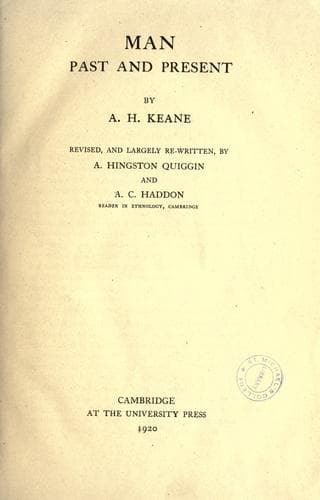
Man, Past and PresentKeane, A. H. (Augustus Henry)
History
Man, Past and Present
Keane, A. H. (Augustus Henry)
Anthropology; Ethnology
Observant travellers have often been impressed by this progressive
conformity of the Mongolo-Turki to Europeans. During his westward
journey through Central Asia Younghusband, on passing from Mongolia to
Eastern Turkestan, found that the people, though tall and fine-looking,
had at first more of the Mongol cast of feature than he had expected.
"Their faces, however, though somewhat round, were slightly more
elongated than the Mongol, and there was considerably more intelligence
about them. But there was more roundness, less intelligence, less
sharpness in the outlines than is seen in the inhabitants of Kashgar and
Yarkand." Then he adds: "As I proceeded westwards I noticed a gradual,
scarcely perceptible, change from the round of a Mongolian type to a
sharper and yet more sharp type of feature.... As we get farther away
from Mongolia, we notice that the faces become gradually longer and
narrower; and farther west still, among some of the inhabitants of
Afghan Turkestan, we see that the Tartar or Mongol type of feature is
almost entirely lost[673]." To complete the picture it need only be
added that still further west, in Asia Minor, the Balkan Peninsula,
Hungary, and Finland, the Mongol features are often entirely lost. "The
Turks of the west have so much Aryan and Semitic blood in them, that the
last vestiges of their original physical characters have been lost, and
their language alone indicates their previous descent[674]."
Before they were broken up and dispersed over half the northern
hemisphere by Mongol pressure from the east, the primitive Turki tribes
dwelt, according to Howorth, mainly between the Ulugh-dagh mountains and
the Orkhon river in Mongolia, that is, along the southern slopes and
spurs of the Altai-Sayan system from the head waters of the Irtysh to
the valleys draining north to Lake Baikal. But the Turki cradle is
shifted farther east by Richthofen, who thinks that their true home lay
between the Amur, the Lena, and the Selenga, where at one time they had
their camping-grounds in close proximity to their Mongol and Tungus
kinsmen. There is nothing to show that the Yakuts, who are admittedly of
Turki stock, ever migrated to their present northern homes in the Lena
basin, which has more probably always been their native land[675].
Public-domain text, read in full here on John Shaqi.
Reviews
Reviews
No reviews yet
Be the first to share your thoughts on this work.
Elsewhere in the archive
Join the Discussion
Join the discussion
Sign in to leave a comment or review.
Sign InorCreate an account