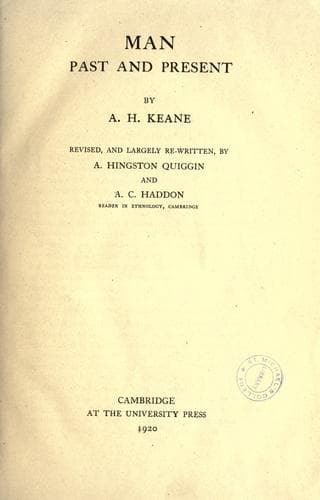
Man, Past and PresentKeane, A. H. (Augustus Henry)
History
Man, Past and Present
Keane, A. H. (Augustus Henry)
Anthropology; Ethnology
Then followed the overthrow of the Yue-chi themselves by the _Ye-tha_
(_Ye-tha-i-li-to_) of the Chinese records, that is, the _Ephthalites_,
or so-called "White Huns," of the Greek and Arab writers, who about 425
A.D. overran Transoxiana, and soon afterwards penetrated through the
mountain passes into the Kabul and Indus valleys. Although confused by
some contemporary writers (Zosimus, Am. Marcellinus) with Attila's Huns,
M. Drouin has made it clear that the Ye-tha were not Huns (Mongols) at
all, but, like the Yue-chi, a Turki people, who were driven westwards
about the same time as the Hiung-nu by the Yuan-yuans (see above). Of
Hun they had little but the name, and the more accurate Procopius was
aware that they differed entirely from "the Huns known to us, not being
nomads, but settled for a long time in a fertile region." He speaks also
of their white colour and regular features, and their sedentary
life[689] as in the Chinese accounts, where they are described as
warlike conquerors of twenty kingdoms, as far as that of the A-si
(Arsacides, Parthians), and in their customs resembling the Tu-Kiu
(Turks), being in fact "of the same race." On the ruins of the
Indo-Scythian (Yue-chi) empire, the White Huns ruled in India and the
surrounding lands from 425 to the middle of the sixth century. A little
later came the Arabs, who in 706 captured Samarkand, and under the
Abassides were supreme in Central Asia till scattered to the winds by
the Oghuz Turki hordes.
From all this it has been suggested that--while the Baktrian peasants
entered India as settlers, and are now represented by the agricultural
Jats--the Yue-chi and Ye-tha, both of fair Turki stock, came as
conquerors, and are now represented by the Rajputs, "Sons of Kings," the
warrior and land-owning race of northern India. It is significant that
these Thakur, "feudal lords," mostly trace their genealogies from about
the beginning of the seventh century, as if they had become Hinduized
soon after the fall of the foreign Ye-tha dynasty, while on the other
hand "the country legends abound with instances of the conflict between
the Rajput and the Brahman in prehistoric times[690]." This supports the
conjecture that the Rajputs entered India, not as "Aryans" of the
Kshatriya or military caste, as is commonly assumed, but as aliens
(Turki), the avowed foes of the true Aryans, that is, the Brahman or
theocratic (priestly) caste. Thus also is explained the intimate
association of the Rajputs and the Jats from the first--the Rajputs
being the Turki leaders of the invasions; and the Jats their peaceful
Baktrian subjects following in their wake.
Public-domain text, read in full here on John Shaqi.
Reviews
Reviews
No reviews yet
Be the first to share your thoughts on this work.
Elsewhere in the archive
Join the Discussion
Join the discussion
Sign in to leave a comment or review.
Sign InorCreate an account