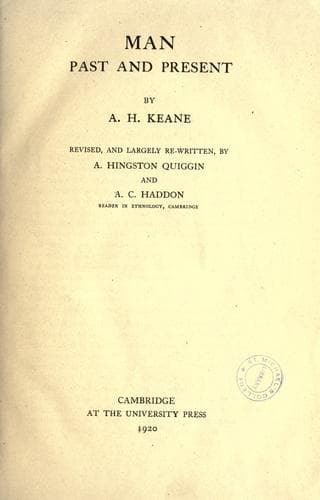
Man, Past and PresentKeane, A. H. (Augustus Henry)
History
Man, Past and Present
Keane, A. H. (Augustus Henry)
Anthropology; Ethnology
The theory that the haughty Rajputs are of unsullied "Aryan blood" is
scarcely any longer held even by the Rajputs themselves; they are
undoubtedly of mixed origin. But the definite physical type which H. H.
Risley[691] describes as characteristic of Rajputs and Jats in the
Kashmir Valley, Punjab and Rajputana, shows them to be wavy-haired
dark-skinned dolichocephals, linked rather with the "Caucasic" than the
"Mongolian" division.
Nearly related to the White Huns were the _Uigurs_, the _Kao-che_ of the
Chinese annals, who may claim to be the first Turki nation that founded
a relatively civilised State in Central Asia. Before the general
commotion caused by the westward pressure of the Hiung-nu, they appear
to have dwelt in eastern Turkestan (Kashgaria) between the Usuns and the
Sacae, and here they had already made considerable progress under
Buddhist influences about the fourth or fifth century of the new era.
Later, the Buddhist missionaries from Tibet were replaced by Christian
(Nestorian) evangelists from western Asia, who in the seventh century
reduced the Uigur language to written form, adapting for the purpose the
Syriac alphabet, which was afterwards borrowed by the Mongols and the
Manchus.
This Syriac script--which, as shown by the authentic inscription of
Si-ngan-fu, was introduced into China in 635 A.D.--is not to be confused
with that of the Orkhon inscriptions[692] dating from 732 A.D., and
bearing a certain resemblance to some of the Runic characters, as also
to the Korean, at least in form, but never in sound. Yet although
differing from the Uiguric, Prof. Thomsen, who has successfully
deciphered the Orkhon text, thinks that this script may also be derived,
at least indirectly through some of the Iranian varieties, from the same
Aramean (Syriac) form of the Semitic alphabet that gave birth to the
Uiguric[693].
It is more important to note that all the non-Chinese inscriptions are
in the Turki language, while the Chinese text refers by name to the
father, the grandfather, and the great-grandfather of the reigning Khan
Bilga, which takes us back nearly to the time when Sinjibu (Dizabul),
Great Khan of the Altai Turks, was visited by the Byzantine envoy,
Zimarchus, in 569 A.D. In the still extant report of this embassy[694]
the Turks ([Greek: Tourkoi]) are mentioned by name, and are described as
nomads who dwelt in tents mounted on wagons, burnt the dead, and raised
to their memory monuments, statues, and cairns with as many stones as
the foes slain by the deceased in battle. It is also stated that they
had a peculiar writing system, which must have been that of these Orkhon
inscriptions, the Uiguric having apparently been introduced somewhat
later.
Public-domain text, read in full here on John Shaqi.
Reviews
Reviews
No reviews yet
Be the first to share your thoughts on this work.
Elsewhere in the archive
Join the Discussion
Join the discussion
Sign in to leave a comment or review.
Sign InorCreate an account