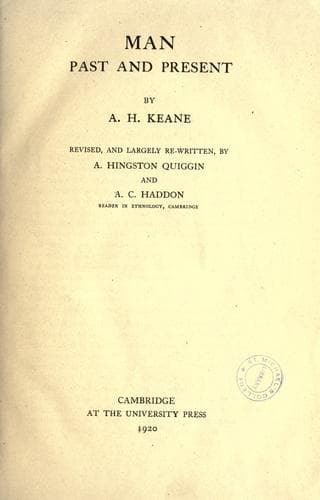
Man, Past and PresentKeane, A. H. (Augustus Henry)
History
Man, Past and Present
Keane, A. H. (Augustus Henry)
Anthropology; Ethnology
Originally the Uigurs comprised nineteen clans, which at a remote period
already formed two great sections:--the On-Uigur ("Ten Uigurs") in the
south, and the Toghuz-Uigur ("Nine Uigurs") in the north. The former had
penetrated westwards to the Aral Sea[695] as early as the second century
A.D., and many of them undoubtedly took part in Attila's invasion of
Europe.
Later, all these Western Uigurs, mentioned amongst the hordes that
harassed the Eastern Empire in the fifth and sixth centuries, in
association especially with the Turki Avars, disappear from history,
being merged in the Ugrian and other Finnish peoples of the Volga basin.
The Toghuz section also, after throwing off the yoke of the Mongol or
Tungus Geugen (Jeu-Jen) in the fifth century, were for a time submerged
in the vast empire of the Altai Turks, founded in 552 by Tumen of the
House of Assena (A-shi-na), who was the first to assume the title of
Kha-Khan, "Great Khan," and whose dynasty ruled over the united Turki
and Mongol peoples from the Pacific to the Caspian, and from the Frozen
Ocean to the confines of China and Tibet. Both the above-mentioned
Sinjibu, who received the Byzantine envoy, and the Bilga Khan of the
Orkhon _stele_, belonged to this dynasty, which was replaced in 774 by
Pei-lo (Huei-hu), chief of the Toghuz-Uigurs. This is how we are to
understand the statement that all the Turki peoples who during the
somewhat unstable rule of the Assena dynasty from 552 to 774 had
undergone many vicissitudes, and about 580 were even broken into two
great sections (Eastern Turks of the Karakoram region and Western Turks
of the Tarim basin), were again united in one vast political system
under the Toghuz-Uigurs. These are henceforth known in history simply as
Uigurs, the On branch having, as stated, long disappeared in the West.
The centre of their power seems to have oscillated between Karakoram and
Turfan in Eastern Turkestan, the extensive ruins of which have been
explored by D. A. Klements, Sven Hedin and M. A. Stein. Their vast
dominions were gradually dismembered, first by the _Hakas_, or
_Ki-li-Kisse_, precursors of the present Kirghiz, who overran the
eastern (Orkhon) districts about 840, and then by the Muhammadans of
Mawar-en-Nahar (Transoxiana), who overthrew the "Lion Kings," as the
Uigur Khans of Turfan were called, and set up several petty Mussulman
states in Eastern Turkestan. Later they fell under the yoke of the
Kara-Khitais, and were amongst the first to join the devastating hordes
of Jenghiz-Khan; their name, which henceforth vanishes from
history[696], has been popularly recognised under the form of "Ogres,"
in fable and nursery tales, but the derivation lacks historical
foundation.
Public-domain text, read in full here on John Shaqi.
Reviews
Reviews
No reviews yet
Be the first to share your thoughts on this work.
Elsewhere in the archive
Join the Discussion
Join the discussion
Sign in to leave a comment or review.
Sign InorCreate an account