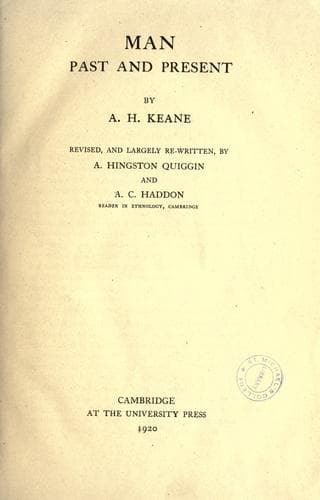
Man, Past and PresentKeane, A. H. (Augustus Henry)
History
Man, Past and Present
Keane, A. H. (Augustus Henry)
Anthropology; Ethnology
Thus were constituted the main branches of the widespread Finnish
family, whose domain formerly extended from the Katanga beyond the
Yenisei to Lapland, and from the Arctic Ocean to the Altai range, the
Caspian, and the Volga, with considerable _enclaves_ in the Danube
basin. But throughout their relatively short historic life the Finnish
peoples, despite a characteristic tenacity and power of resistance, have
in many places been encroached upon, absorbed, or even entirely
eliminated, by more aggressive races, such as the Siberian "Tatars" in
their Altai cradleland, the Turki Kirghiz and Bashkirs in the West
Siberian steppes and the Urals, the Russians in the Volga and Lake
districts, the Germans and Lithuanians in the Baltic Provinces (Kurland,
Livonia, Esthonia), the Rumanians, Slavs, and others in the Danube
regions, where the Ugrian Bulgars and Magyars have been almost entirely
assimilated in type (and the former also in speech) to the surrounding
European populations.
Few anthropologists now attach much importance to the views not yet
quite obsolete regarding a former extension of the Finnish race over
the whole of Europe and the British Isles. Despite the fact that all the
Finns are essentially round-headed, they were identified first with the
long-headed cavemen, who retreated north with the reindeer, as was the
favourite hypothesis, and then with the early neolithic races who were
also long-headed. Elaborate but now forgotten essays were written by
learned philologists to establish a common origin of the Basque and the
Finnic tongues, which have nothing in common, and half the myths,
folklore, and legendary heroes of the western nations were traced to
Finno-Ugrian sources.
Now we know better, and both archaeologists and philologists have made
it evident that the Finnish peoples are relatively quite recent arrivals
in Europe, that the men of the Bronze Age in Finland itself were not
Finns but Teutons, and that at the beginning of the new era all the
Finnish tribes still dwelt east of the Gulf of Finland[715].
Public-domain text, read in full here on John Shaqi.
Reviews
Reviews
No reviews yet
Be the first to share your thoughts on this work.
Elsewhere in the archive
Join the Discussion
Join the discussion
Sign in to leave a comment or review.
Sign InorCreate an account