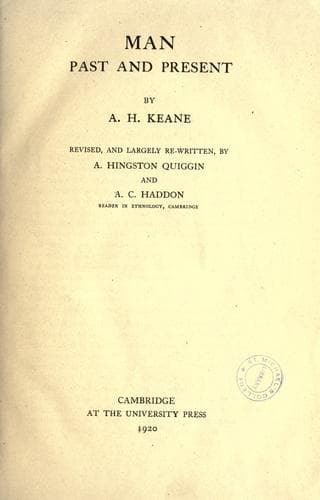
Man, Past and PresentKeane, A. H. (Augustus Henry)
History
Man, Past and Present
Keane, A. H. (Augustus Henry)
Anthropology; Ethnology
Not only so, but the eastern migrations themselves, as above roughly
outlined, appear to have taken place at a relatively late epoch, long
after the inhabitants of West Siberia had passed from the New Stone to
the Metal Ages. J. R. Aspelin, "founder of Finno-Ugrian archaeology,"
points out that the Finno-Ugrian peoples originally occupied a
geographical position between the Indo-Germanic and the Mongolic races,
and that their first Iron Age was most probably a development, between
the Yenisei and the Kama, of the so-called Ural-Altai Bronze Age, the
last echoes of which may be traced westwards to Finland and North
Scandinavia. In the Upper Yenisei districts iron objects had still the
forms of the Bronze Age, when that ancient civilisation, associated with
the name of the "Chudes," was interrupted by an invasion which
introduced the still persisting Turki Iron Age, expelled the aboriginal
inhabitants, and thus gave rise to the great migrations first of the
Finno-Ugrians, and then of the Turki peoples (Bashkirs, Volga "Tatars"
and others) to and across the Urals. It was here, in the Permian
territory between the Irtysh and the Kama, that the West Siberian
(Chudish) Iron Age continued its normal and unbroken evolution. The
objects recovered from the old graves and kurgans in the present
governments of Tver and Iaroslav, and especially at Ananyino on the
Kama, centre of this culture, show that here took place the transition
from the Bronze to the Iron Age some 300 years before the new era, and
here was developed a later Iron Age, whose forms are characteristic of
the northern Finno-Ugrian lands. The whole region would thus appear to
have been first occupied by these immigrants from Asia after the
irruption of the Turki hordes into Western Siberia during the first Iron
Age, at most some 500 or 600 years before the Christian era. The
Finno-Ugrian migrations are thus limited to a period of not more than
2600 years from the present time, and this conclusion, based on
archaeological grounds, agrees fairly well with the historical,
linguistic, and ethnical data.
Public-domain text, read in full here on John Shaqi.
Reviews
Reviews
No reviews yet
Be the first to share your thoughts on this work.
Elsewhere in the archive
Join the Discussion
Join the discussion
Sign in to leave a comment or review.
Sign InorCreate an account